The United Kingdom sits between India and the United States on the spectrum of medical advertising freedom. British doctors are allowed to advertise their services — there is no blanket prohibition as there is in India — but the advertising is policed by several bodies at once, and one of the rules is not merely a professional standard but a criminal offence: it is illegal to advertise a prescription-only medicine to the public. That single rule, more than any other, defines how whole categories of UK healthcare — cosmetic injectables, weight-loss clinics, erectile-dysfunction services — are permitted to market themselves. This guide explains the whole framework and the recent enforcement that has made it bite.
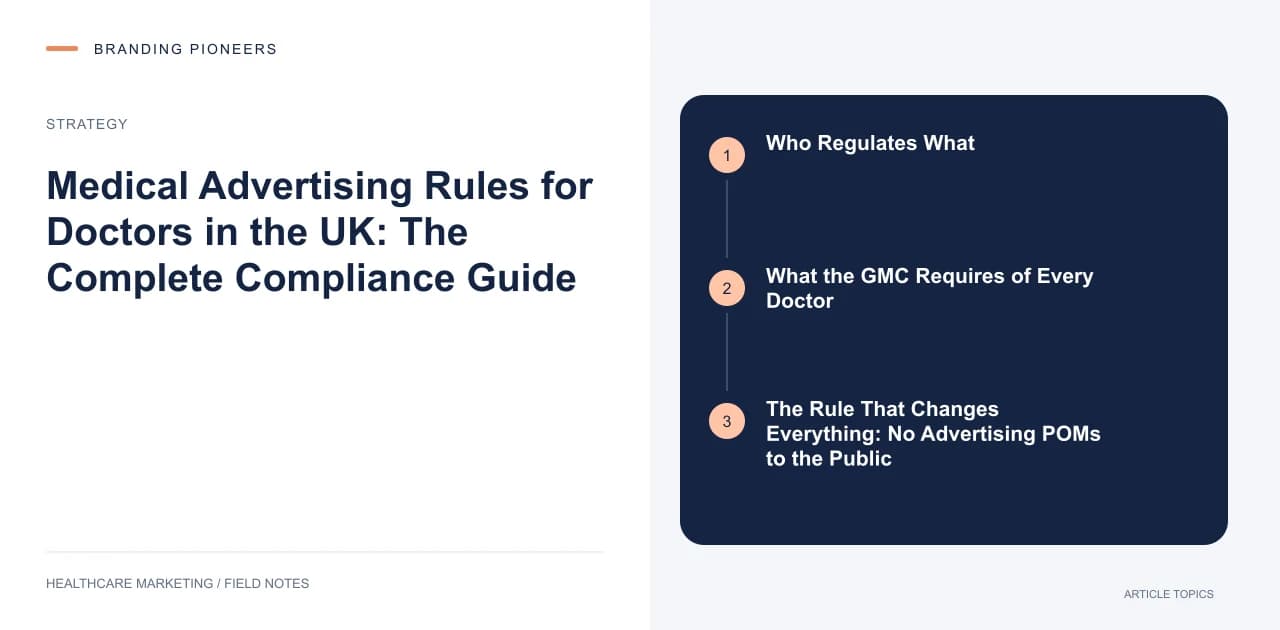
Who Regulates What
Four bodies matter most. The General Medical Council (GMC) sets the professional standards every doctor must meet, in Good Medical Practice and in dedicated guidance for doctors who offer cosmetic interventions; breaching them is a fitness-to-practise matter that can end in suspension or erasure from the register. The Advertising Standards Authority (ASA) enforces the CAP Code (non-broadcast advertising) and BCAP Code (broadcast), which require that ads be truthful, substantiated, and socially responsible. The MHRA (Medicines and Healthcare products Regulatory Agency) enforces the rules on advertising medicines, including the criminal ban on promoting prescription-only medicines to the public. And the CQC (in England; with separate regulators in Wales, Scotland, and Northern Ireland) registers and inspects providers carrying on regulated activities such as surgery. The CMA adds a consumer-protection overlay and, since April 2025, has direct power to fine for unfair commercial practices.
What the GMC Requires of Every Doctor
The GMC's duties, drawn from Good Medical Practice (2024), are the baseline. Published information about your services must be factual and verifiable, and not false or misleading. You must not make unjustifiable claims about the quality of your services. You must not offer guarantees of cures, nor claim or imply that an intervention is risk-free. You must not exploit patients' vulnerability or lack of medical knowledge, and you must not put pressure on people to use a service by playing on their fears or dangling inducements. And you must be honest and open about any financial or commercial interests when you promote or endorse a product or service.
For cosmetic interventions the GMC goes further. You must market responsibly, must not trivialise the risks, and — importantly — must not use promotional tactics that could push someone into an ill-considered decision. That explicitly includes time-limited financial offers ("today only") and two-for-one or package deals, which are treated as pressure selling for irreversible procedures.
The Rule That Changes Everything: No Advertising POMs to the Public
Here is the rule that catches the most practices and is the most serious, because it is criminal. Under the CAP Code (rule 12.12) and, behind it, the Human Medicines Regulations 2012, prescription-only medicines may not be advertised to the public at all. You also may not use a health professional or celebrity to endorse a medicine.
The crucial subtlety is how broadly "advertising a POM" is read. The ASA's working principle is that any reference to a prescription-only medicine is likely to amount to promoting it. That sweeps in not just brand names (Botox, Dysport; Ozempic, Wegovy, Mounjaro) but the proxies people reach for to get around the brand: "anti-wrinkle injections," "wrinkle relaxers," "#brotox," "weight-loss injections," "skinny jab," "weight-loss pen," "GLP-1," and even describing the condition the drug treats as a route to selling it. Imagery counts too — syringes, vials, injection pens, and before-and-after photos are all treated as promotion.
The permitted approach is a narrow one the ASA sums up as "promote the consultation, not the POM." A clinic may advertise a consultation ("a consultation about lines and wrinkles," "a weight-management consultation") without naming or depicting the prescription medicine. A clinic's own website may give purely factual information about a POM only in a narrow, non-promotional way reached after a consultation page — never on the homepage, never in an ad, never with testimonials or promotional language.
This is not theoretical. CAP issued a formal enforcement notice on Botox advertising on social media, the ASA has ruled against influencers promoting it, and in September 2025 the ASA, MHRA, and the pharmacy regulator issued a joint enforcement notice to all registered pharmacies over weight-loss medicine advertising, with monitoring of tens of thousands of ads and formal action against multiple advertisers. The ASA now uses AI to scan social media for these breaches at scale.