If you have read our guide to India's medical advertising rules, the United States will feel like a different planet. In India the default is "doctors may not advertise." In the US the default is the opposite: truthful, non-misleading physician advertising is constitutionally protected commercial speech. Ever since the Supreme Court's decision in Bates v. State Bar of Arizona (1977), professional advertising has been protected by the First Amendment, and states may regulate false or deceptive advertising but cannot ban truthful advertising outright.
So the American rule, in one sentence, is this: you may advertise — just never lie, never mislead, and never expose patient information without permission. That sounds simple, and at the level of principle it is. But underneath it sits a dense stack of federal and state law — the FTC, FDA, HIPAA, the TCPA, the federal Anti-Kickback Statute and Stark Law, fifty different state medical boards, and a brand-new FTC rule on fake reviews — and a single careless campaign can breach several of them at once. This guide walks through all of it and ends with a practical playbook for marketing a US practice safely. (As always: this is general information, not legal advice. Verify specifics with a healthcare attorney and your state board.)
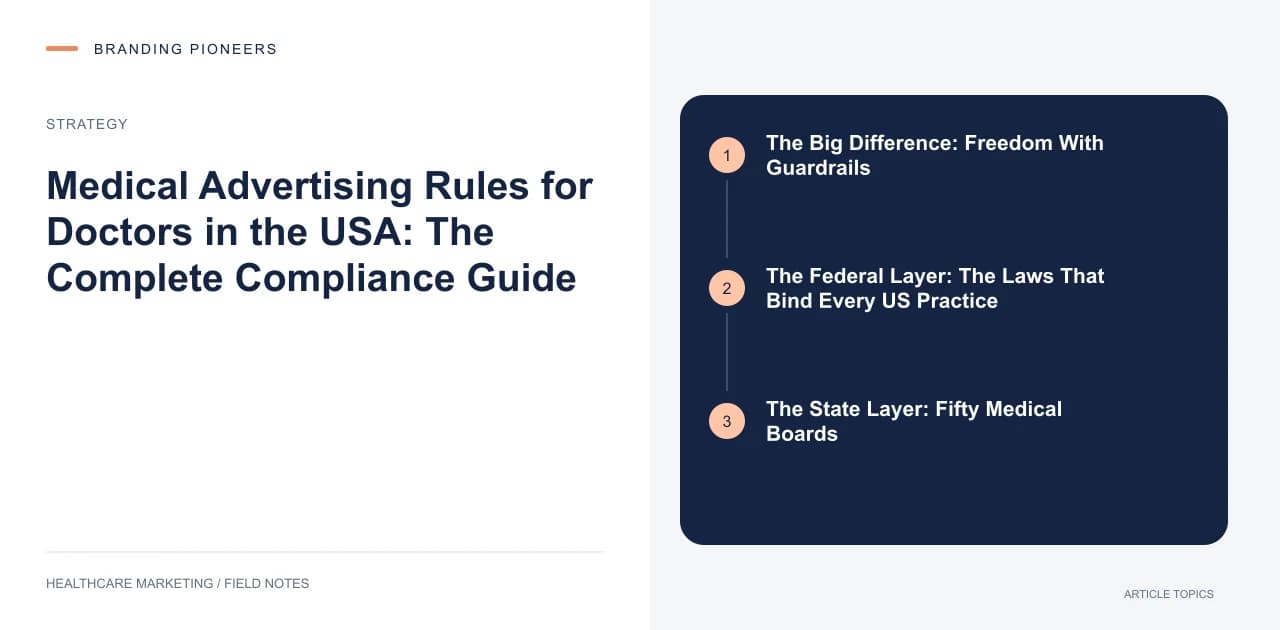
The Big Difference: Freedom With Guardrails
The reason US doctors can do things their Indian counterparts cannot — name prices, run comparative ads, publish patient testimonials, advertise specific procedures — is that American law treats medical advertising as commercial speech that the public benefits from receiving, rather than as solicitation that must be suppressed. The state's role is limited to policing deception.
That single philosophical difference cascades into everything below. The American questions are never "am I allowed to advertise this?" They are "is this claim true, is it substantiated, is it misleading in its overall impression, and do I have the right consents?" Get those four right and you have enormous latitude. Get them wrong and the penalties are severe.
The Federal Layer: The Laws That Bind Every US Practice
The FTC Act is the master rule of truthful advertising. The Federal Trade Commission requires that advertising be truthful and not misleading, and — critically — that claims be substantiated before they are made. For health claims specifically, the FTC applies a high bar it calls "competent and reliable scientific evidence," which for a meaningful health benefit generally means well-designed human clinical studies. This applies to express claims and to implied claims, and the FTC looks at the "net impression" an ad creates: an advertisement every word of which is literally true can still be illegal if the overall impression misleads. A disclaimer in fine print cannot rescue an ad that is deceptive on its face.
HIPAA governs every use of patient information in marketing — and this is where most practices stumble. Under the HIPAA Privacy Rule, using protected health information for marketing generally requires a valid, written patient authorization. That includes patient testimonials, patient names, patient stories, and patient photographs — and yes, before-and-after photos are protected health information. There are only narrow exceptions (face-to-face communications and nominal promotional gifts). The authorization must be specific about what is being used and for how long, it is revocable, and if the practice is being paid by a third party in connection with the marketing, that must be disclosed. The practical rule: never put a real patient's image, words, or story into your marketing without a signed HIPAA authorization on file, and never reuse it beyond what they authorized.
HIPAA also limits how you respond to reviews. This catches many doctors by surprise. When a patient leaves a negative online review, you may not confirm in your public reply that the person was even a patient, and you certainly may not discuss their care — doing so discloses protected health information, and the federal Office for Civil Rights has penalized providers for exactly this. Respond generically and move specifics to a private channel.
The FDA governs the promotion of prescription drugs and medical devices. Most of its rules bind manufacturers, but a practice that promotes a specific branded drug or device — a med-spa marketing a branded injectable, for example — can be drawn into them.
The TCPA governs marketing by phone and text. Marketing calls or texts sent by autodialer or with a prerecorded voice generally require prior express written consent. Statutory damages run at a fixed amount per message and rise for willful violations, with no aggregate cap — which is why TCPA class actions are a genuine business risk, not a footnote.
The Anti-Kickback Statute and Stark Law turn certain marketing arrangements into federal offences. If a "marketing" deal is really a payment for referrals of patients whose care is billed to a federal program — per-patient lead-generation fees, affiliate referral cuts, paid arrangements dressed up as marketing — it can be a kickback. The Anti-Kickback Statute is criminal and requires intent; Stark is civil and is strict-liability. Many states have their own anti-kickback and fee-splitting laws that apply even to cash-pay practices outside the reach of federal programs.
The State Layer: Fifty Medical Boards
On top of all that federal law, every state medical board independently prohibits false, deceptive, or misleading advertising and can discipline the individual physician's license. The FTC regulates the business; the board regulates the doctor. The rules vary materially from state to state.
The most common state-level trap is board-certification and specialist claims. Many states (California and Texas are leading examples) only permit a physician to advertise as "board certified" if the certifying board is a recognized one — typically a member board of the American Board of Medical Specialties or an equivalent. Advertising "board eligible," or claiming a specialty you are not certified in, or implying surgical training you do not have while marketing cosmetic surgery, is a recurring source of board discipline. If you advertise credentials, make sure they are stated precisely and are from a qualifying body.