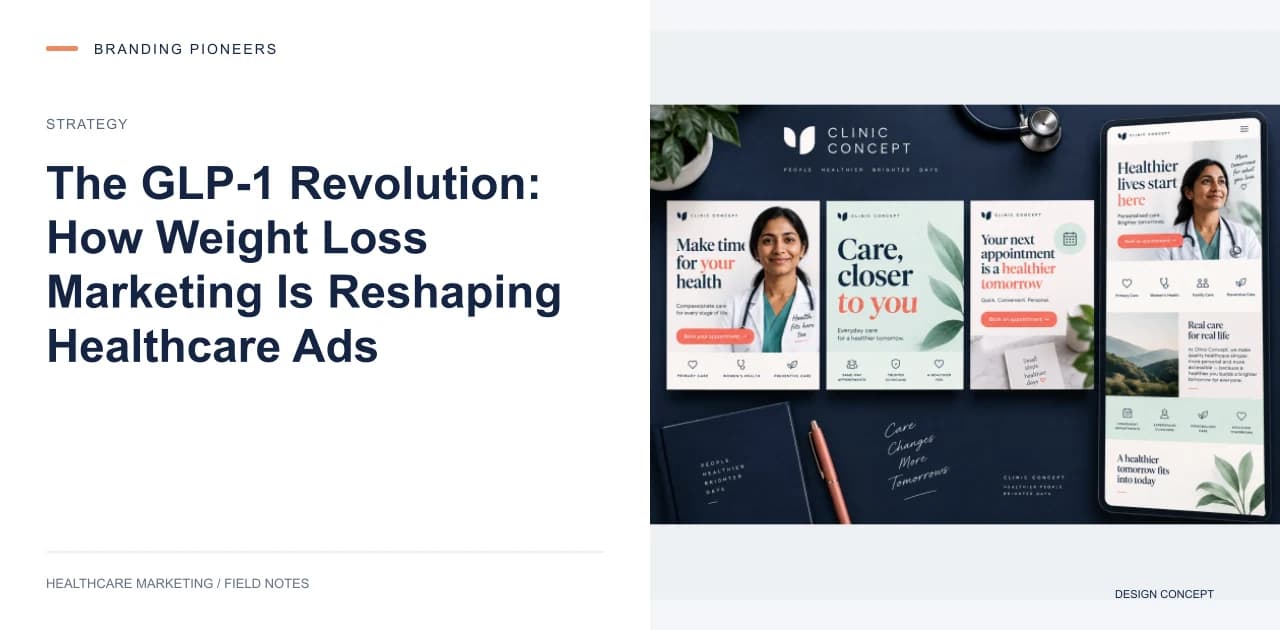
The Drug That Broke Healthcare Advertising
Ozempic (semaglutide) and Mounjaro (tirzepatide) did not just change obesity medicine. They changed the advertising landscape for every hospital, clinic, and healthcare brand that offers weight management services.
Before GLP-1 medications became household names — roughly before 2023 — weight management healthcare marketing was dominated by surgical options (bariatric surgery) and lifestyle programs (diet, exercise, behavioral coaching). The marketing was relatively uncrowded and patient decision journeys were long.
Starting in 2023 and accelerating dramatically through 2024 and 2025, pharmaceutical companies began running enormous direct-to-consumer advertising campaigns for GLP-1 medications globally. In India, where the branded versions (Wegovy, Ozempic, Mounjaro) became available at ₹5,000 to ₹18,000 per month, search volumes for "weight loss injection," "Ozempic India," "semaglutide India," and "weight loss medication India" grew dramatically.
The patient population that was previously searching for bariatric surgeons or weight loss programs is now splitting into a new decision framework: medication vs surgery vs supervised program vs combination approach. And pharmaceutical marketing budgets — which are enormous relative to most hospital marketing budgets — are actively shaping patient perceptions.
Healthcare marketers who have not adapted to this new reality are losing patient inquiries to pharmaceutical messaging they cannot match in volume or spend.
Understanding the New Patient Journey
The patient arriving at your weight management program in 2026 is not the same patient who arrived in 2022.
In 2022: "I want to lose weight. What are my options?" The hospital or clinic was often the first touchpoint.
In 2026: "I've seen a lot about Ozempic. Is it right for me? My doctor mentioned Mounjaro but it's expensive. Someone told me about bariatric surgery. I don't know what to do."
The patient is arriving with pre-formed opinions from pharmaceutical advertising, social media (celebrity Ozempic discourse is enormous), their GP, and online communities. Your marketing needs to meet them at this more complex, more informed decision stage.
The patient questions that are now driving weight management searches:
- "Ozempic vs bariatric surgery: which is better for weight loss?"
- "Is Ozempic safe long-term?"
- "Can I get GLP-1 medication without a prescription in India?"
- "What happens when you stop taking Ozempic?"
- "Who qualifies for weight loss injections in India?"
These are not questions about your hospital. They are questions about the medication class. If your website and content answer these questions honestly and thoroughly, you capture the research traffic AND establish authority on the topic.
The Positioning Challenge: Where Does Your Hospital Fit?
There are four positioning options for hospitals and clinics with weight management programs:
Option 1: GLP-1 Program Provider
Offer GLP-1 medications through your endocrinology or weight management department as a medically supervised program. This captures patients who want the medication but want physician oversight (which is appropriate — GLP-1 medications require monitoring for side effects, dose adjustments, and contraindication assessment).
Marketing angle: "Medically supervised GLP-1 programs with comprehensive monitoring — not just a prescription, but a complete weight management protocol."
This works well for large hospitals and specialty clinics that can offer the full program (medication + nutritional counseling + regular monitoring + side effect management).
Option 2: Surgery as the Long-Term Solution
For bariatric programs, position surgery as the sustainable answer where medication falls short.
The clinical reality that pharmaceutical advertising does not advertise: weight lost on GLP-1 medications is substantially regained when the medication is stopped. Long-term data consistently shows that most of the weight lost is regained within a year of stopping semaglutide. Bariatric surgery, by contrast, produces durable 5 to 10 year weight loss outcomes.
Marketing angle: "GLP-1 medications work while you take them. Bariatric surgery works for life." This is clinically defensible, patient-relevant, and directly addresses the comparison question patients are already asking.
Do not make this an attack on GLP-1 medications — that looks defensive and clinically uninformed (the drugs do work; they just have a sustainability problem). Frame it as "here is how the tools compare, and here is when surgery is the right choice."
Option 3: Comprehensive Multidisciplinary Program
Position your hospital as the option that integrates all approaches: GLP-1 medications for patients who qualify, behavioral and nutritional therapy, and surgical options for appropriate candidates, all coordinated by a multidisciplinary team.
This is the strongest positioning for high-acuity weight management centers but requires actual clinical infrastructure to support — you cannot claim "multidisciplinary" if you have one bariatric surgeon and refer out for everything else.
Option 4: Post-GLP-1 Surgical Services
An emerging positioning: for patients who tried GLP-1 medications, lost substantial weight, stopped the medication, and regained it — or for patients who had a partial response and need additional intervention.
"Already tried weight loss medications? Here is where surgery fits into your journey." This captures a patient pool that will grow substantially over the next 3 to 5 years as the initial wave of GLP-1 users encounters the sustainability problem.
What to Advertise and How
Search Advertising: Capture Comparison Queries
The highest-intent search traffic in weight management is now the comparison queries. Bid on:
- "Ozempic vs bariatric surgery India"
- "GLP-1 weight loss program [city]"
- "Mounjaro alternatives India"
- "Weight loss injection supervised program"
- "Bariatric surgery cost vs Ozempic cost"
These keywords are less competitive than pure bariatric terms and capture patients in the research phase — exactly the decision-making moment where great content converts.
Content Marketing: The Comparison Framework
A comprehensive comparison guide — "Ozempic, Mounjaro, Bariatric Surgery, and Lifestyle Programs: A Clinical Comparison for Indian Patients" — is the single highest-value content asset a weight management center can publish right now.
It should cover:
- How each approach works mechanically
- Short-term weight loss expectations
- Long-term sustainability data
- Side effects and risks of each
- Who is a candidate for each option (by BMI, comorbidities, history)
- Cost comparison over 1, 3, and 5 years (this is striking — long-term GLP-1 use often costs significantly more than bariatric surgery)
This type of genuinely balanced comparison content builds trust and ranks for high-volume informational queries simultaneously.
Social Media: Meet Patients in the GLP-1 Conversation
GLP-1 medications are one of the most-discussed health topics on Instagram and YouTube in India right now. Content that enters this conversation authentically (not defensively) builds audience.
Instagram content that works:
- "Week 12 on Ozempic: what the clinical data actually shows" (educational, engages the existing interested audience)
- "5 questions to ask your doctor before starting GLP-1 medications" (helpful, positions your physicians as advisors)
- "The hidden costs of Ozempic over 5 years vs bariatric surgery" (comparison framing that is surprising and shareable)
The physicians who are engaging with the GLP-1 conversation on social media right now — not attacking it, but explaining the clinical nuances — are building the audiences that will trust them for high-value weight management decisions in the coming years.
Develop Your Weight Management Marketing Strategy for the GLP-1 Era →
Filed underGLP-1 weight loss marketingOzempic marketing Indiaweight loss healthcare marketingbariatric vs GLP-1 marketingsemaglutide India marketing

About the author
Nishu Sharma
Founder & CEO · Gurugram, India
Nishu founded Branding Pioneers in 2016 with one rule that hasn't changed since: healthcare only. She'd run digital strategy at a top-10 Indian agency and watched generalist marketing underserve medical clients who needed something built for how patients actually search and decide. So she left to build the specialist instead. It's now an 80-person team working with healthcare brands worldwide.
Free guide · 17 pages
The Patient Acquisition Blueprint
A 90-day plan from first search to booked appointment.