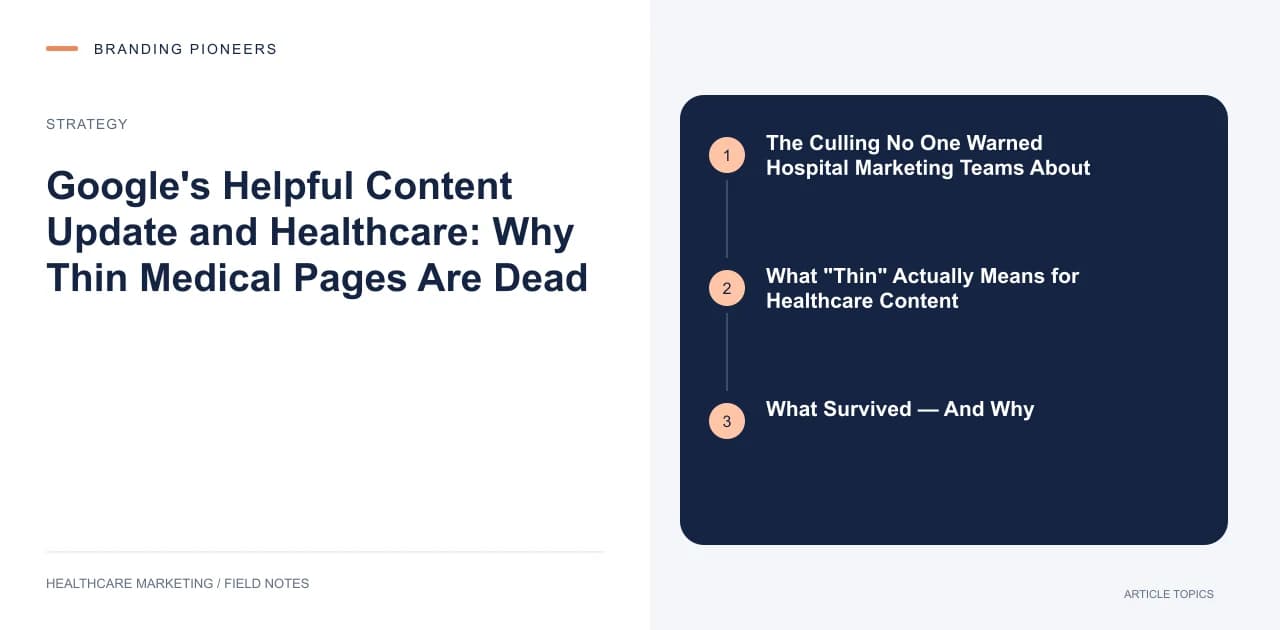
The Culling No One Warned Hospital Marketing Teams About
Between August 2022 and March 2025, Google ran a series of algorithm updates collectively labeled the Helpful Content System. The specific target: content written primarily for search engines rather than for people. Content that existed to rank, not to genuinely help the reader.
Healthcare was hit harder than almost any other category.
The reason is structural. Healthcare content is classified as YMYL — Your Money or Your Life — meaning Google holds it to a higher standard than content about, say, kitchen appliances. Inaccurate or unhelpful healthcare content can lead people to delay treatment, choose the wrong medication, or misunderstand a diagnosis. Google's response to this risk is aggressive: penalize healthcare content that provides minimal genuine information.
The collateral damage was enormous. Traffic analysis across the hospital and clinic websites we manage showed significant informational page traffic drops between 2022 and 2025. Pages that had ranked for years — "symptoms of appendicitis," "what is Type 2 diabetes," "knee replacement surgery procedure" — dropped out of the top 10 because they were templated, shallow, or structured primarily around keywords rather than patient needs.
Understanding what changed — and specifically why certain pages disappeared while others held — is the only way to rebuild properly.
What "Thin" Actually Means for Healthcare Content
"Thin content" sounds like a word count problem. It is not. The Helpful Content System evaluates content on dimensions that have nothing to do with word count:
Original information vs regurgitation. A 3,000-word page on "symptoms of hypothyroidism" that is assembled from existing medical sources and adds no original perspective, no hospital-specific data, no clinical expertise, no patient-relevant context — this is thin content, regardless of its length.
Satisfaction of search intent. A patient searching "knee replacement recovery timeline" wants to know: how long before I walk normally? When can I drive? When can I return to work? When can I exercise? A page that discusses the surgical procedure in detail but buries or omits the recovery questions is not satisfying the intent, regardless of its technical accuracy.
Evidence of expertise. Google's guidelines for YMYL content are explicit: expertise, authoritativeness, and trustworthiness (E-E-A-T) must be demonstrable, not just claimed. A page that says "written by a healthcare professional" but has no named author, no credentials, no institutional affiliation, and no citations does not demonstrate expertise — it asserts it.
Content written for the site vs for the reader. Pages stuffed with keyword variants ("knee replacement Delhi," "knee replacement surgery Delhi," "Delhi knee surgery cost," "best knee replacement in Delhi" repeated throughout the content) rather than genuinely answering patient questions fail the "for people" test.
What Survived — And Why
Not all healthcare content lost traffic. Pages that maintained or grew rankings share identifiable characteristics.
Specificity of experience. Pages written from the perspective of a specific hospital's actual practice — our outcomes data, our specific approach to a procedure, our patients' specific experiences — survived because they contain information that cannot be found elsewhere. A page on "Narayana Health Bangalore coronary artery bypass surgery outcomes" is inherently unique. A page on "coronary artery bypass surgery" that says the same things every other page says is not.
Named, credentialed authorship. Pages with clearly identified physician authors, complete with qualifications, clinical specialization, and hospital affiliation, fared significantly better than pages with generic "healthcare team" or "medical staff" bylines. Google's systems appear to validate YMYL authorship through cross-referencing author information against external signals (LinkedIn profiles, medical journal publications, hospital website staff pages).
Comprehensive intent satisfaction. Pages that answered the full spectrum of patient questions around a topic — including the questions patients do not know they should ask — consistently held rankings. One Delhi hospital group's orthopedic content, written in first person by a named surgeon and covering the clinical decision-making process, patient selection criteria, procedure details, and realistic recovery expectations, held its rankings through every helpful content update.
Structural clarity. Pages organized around patient decision stages (should I see a doctor? Which doctor? What will they recommend? What does the procedure involve? What does recovery look like? What does it cost?) rather than medical taxonomy performed better. Patients are not learning a medical field — they are making a decision.
The New Content Playbook for Healthcare
What to Build Instead of Generic Condition Pages
Decision-support content. "When should you see a cardiologist vs your GP?" "Is this back pain worth seeing a specialist?" These pages address the earliest stage of patient decision-making — "do I need to do something about this?" — and have extremely high intent specificity.
Procedure-specific pages with actual outcome data. Not "knee replacement surgery in India" but "knee replacement at [Your Hospital]: our surgical approach, outcomes data, patient selection criteria, and what you should ask us at your consultation." Use your own hospital's data: complication rates, readmission rates, return-to-activity timelines, patient satisfaction scores.
Doctor-authored clinical perspective pieces. A 1,200-word piece written by Dr. Meera Krishnan explaining her approach to managing high-risk pregnancies at Rosewalk Hospital, covering her patient selection process, her preferred monitoring protocols, and what she tells anxious patients — this is irreplaceable content. It cannot be found anywhere else. It demonstrates specific expertise from a specific, identifiable expert. It satisfies the patient intent of "who should I trust with my high-risk pregnancy?"
Cost and insurance reality pages. "What does a cardiac stent procedure actually cost at [Hospital]? Here is the breakdown including procedure fee, ICU stay, medication, and follow-up." Patients search for this information and are almost universally underserved by healthcare websites that either omit pricing entirely or give ranges so broad as to be useless.
Comparative context without advertising. "Is robotic surgery right for your prostate cancer? Here is how to think about the decision, including cases where it is the best choice and cases where it may not be." This type of genuinely balanced clinical education is exactly what Google's helpful content guidelines reward: content that helps people make informed decisions rather than content designed to funnel them toward a purchase.
The Author Credentialing Protocol
Every piece of healthcare content on your site needs to be attributable to a specific expert with verifiable credentials.
Implementation steps:
- Create individual author pages for every physician who contributes content, with their full qualifications, specialization, years of experience, and institutional affiliation
- Add author schema markup to every article connecting the byline to the author page
- Link author pages to their profiles on the hospital's official staff directory, their LinkedIn, and any medical publication bylines
- Include a content accuracy date and a "reviewed by" field for pages that are periodically updated
This creates the verification trail that Google's YMYL systems look for when assessing the trustworthiness of medical content.
What to Do With Your Existing Thin Pages
Audit every informational page on your site with this question: if a patient reads this page, do they leave with information they could not easily find on the first ten other healthcare sites? If the answer is no, the page has four options:
- Rewrite substantially — Add genuine clinical expertise, original data, and patient-decision-relevant information that makes the page uniquely valuable
- Consolidate — Multiple thin pages on related topics can be merged into one comprehensive, genuinely useful resource
- Redirect — Redirect the thin page to a more comprehensive page on the same topic
- Delete — For pages with zero traffic, zero links, and no rehabilitation potential, removal and 301 redirect is often the cleanest option
Option 4 should not be taken lightly, but leaving dozens of thin, low-quality pages indexed actively harms your domain's overall quality signals. Google evaluates site quality holistically — a large number of thin pages on your domain pulls down the evaluation of your better pages.
The healthcare content that survives and thrives in 2026 is the content that only you can write. Your doctors' clinical perspectives. Your outcomes data. Your patients' stories (with consent). Your specific approach to diagnosis and treatment. Your facility's capabilities and limitations. No AI can fabricate this, no competitor can replicate it, and Google's systems are increasingly good at distinguishing it from the content that pretends to expertise without having earned it.
Audit and Rebuild Your Healthcare Content for 2026 — Get an Assessment →
Filed underGoogle helpful content healthcarehelpful content update medicalhealthcare content SEO 2026medical content Google rankingYMYL healthcare content

About the author
Arush Thapar
Co-Founder & CTO · Gurugram, India
Arush builds the systems the rest of the company runs on — the patient-acquisition pipelines, the AI chatbots, the analytics that tie a single click to a booked appointment. If a campaign reports a number, it's because something his team built is tracking it.
Free guide · 17 pages
The Patient Acquisition Blueprint
A 90-day plan from first search to booked appointment.