Google Ads Catch the Fish That Are Already Biting. Meta Ads Fill the Pond.
When a patient searches "knee replacement surgeon near me" on Google, they have already decided they need help. Google Ads captures that demand. But for every patient actively searching, there are 50 who have knee pain, have not searched yet, and do not know that their morning stair struggle is something a surgeon can fix.
Meta ads — Facebook and Instagram — reach those 50 people. They are scrolling through their feed, see your ad about knee pain solutions, and suddenly the thing they have been ignoring for six months has a name, a solution, and a doctor who can help.
This is demand creation, not demand capture. And for healthcare practices, it is the most underutilized growth channel available.
We manage Meta ad campaigns for healthcare clients. The practices that use Meta alongside Google Ads generate noticeably more total patients than those running Google alone. But Meta ads for healthcare play by different rules. The targeting is different. The creative is different. The compliance is different. Here is how to do it right.
Why Meta Ads Work for Healthcare (The Psychology)
Healthcare decisions are emotional. A patient does not decide to get knee surgery because they saw a PPC ad. They decide because:
- They are in pain (physical trigger)
- They see someone else who had the surgery and is doing well (social proof)
- They feel reassured that the process is manageable (anxiety reduction)
- They trust the doctor (credibility)
Meta ads deliver triggers 2, 3, and 4 directly into the patient's feed. A video testimonial of a patient walking pain-free after knee replacement. A doctor explaining the procedure in plain language. A before-and-after smile transformation.
These are not ads in the traditional sense. They are trust-building content placed in front of people who need it. The patient does not feel sold to. They feel informed. And informed patients book.
The Healthcare Meta Ads Playbook
Campaign Structure: The Three-Layer Funnel
Layer 1: Awareness (top of funnel) Objective: Video views or engagement Audience: Broad targeting by age, location, and relevant interests Content: Educational videos, doctor introductions, health tips Budget: 20 to 30 percent of total Meta spend Goal: Get your practice seen by potential patients who are not yet searching
Layer 2: Consideration (middle of funnel) Objective: Traffic or lead generation Audience: People who watched 50 percent or more of your Layer 1 videos, website visitors, engaged followers Content: Patient testimonials, procedure explainers, cost information Budget: 30 to 40 percent of total Meta spend Goal: Move interested people toward taking a next step
Layer 3: Conversion (bottom of funnel) Objective: Lead generation or conversions Audience: People who visited your service pages, engaged with consideration content, or started but did not complete a booking form Content: Direct CTAs, limited-time consultation offers, "book now" messaging Budget: 30 to 40 percent of total Meta spend Goal: Convert warm prospects into booked appointments
Targeting: What Works for Healthcare on Meta
Meta's targeting has changed significantly after privacy regulations. You cannot target people based on health conditions, medical treatments, or specific diagnoses. You cannot create audiences of "people interested in knee replacement."
What you can do:
Demographic targeting: Age ranges that match your patient profile. A knee replacement practice targets 45 to 70. A pediatric dentist targets parents aged 25 to 45. An IVF clinic targets couples aged 28 to 42.
Geographic targeting: Radius around your practice location. Tighter for general services (5 to 10 km), wider for specialty services (20 to 50 km).
Interest targeting: Related but not medical interests. "Fitness," "running," "golf" for orthopedics (active people who might injure themselves). "Wedding planning," "beauty" for cosmetic dentistry. "Parenting" for pediatrics.
Lookalike audiences: Upload your existing patient list (emails or phone numbers). Meta finds people who share similar characteristics. This is the highest-performing targeting method we use. Lookalike audiences of existing patients consistently outperform interest-based targeting by a wide margin.
Retargeting audiences: Website visitors who did not convert. Video viewers. People who engaged with previous ads. These warm audiences convert far better than cold audiences.
Creative: What Gets Healthcare Patients to Stop Scrolling
The median Facebook user scrolls right past most posts in a couple of seconds. You do not have long to stop them. Here is what works:
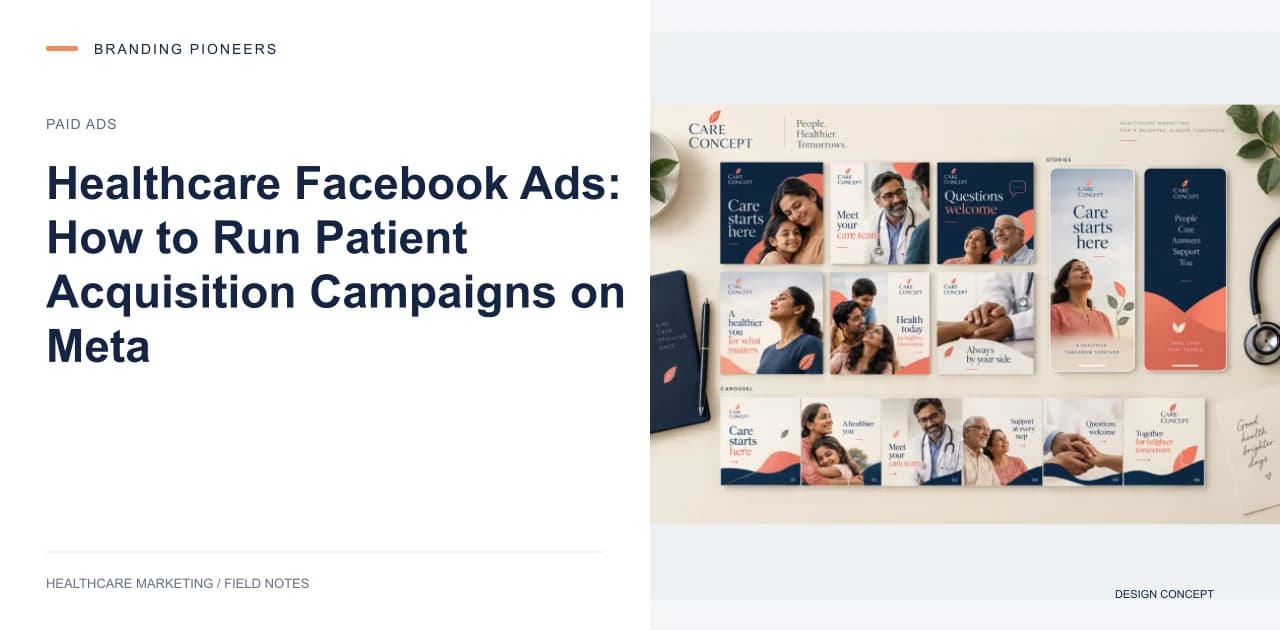
Patient testimonial videos. A real patient, on camera, sharing their experience. 30 to 60 seconds. Shot on a phone in the clinic. Not overproduced. Authentic beats polished every time.
Performance data: patient testimonial videos generate meaningfully more engagement and a better conversion rate than any other creative format we have tested in healthcare.
Doctor-to-camera educational videos. Your surgeon explaining a procedure in 60 seconds. "Hi, I am Dr. Sharma. If you have been dealing with knee pain for more than 3 months, here is what might be happening..." Direct, warm, informative.
Before-and-after carousels. For visual specialties (dental, cosmetic surgery, dermatology, hair transplant). Show 3 to 5 transformations in a carousel format. Each card: before image, after image, brief description.
Note: Meta restricts before-and-after imagery for cosmetic procedures. The images must be realistic, not imply guaranteed results, and include appropriate disclaimers. We recommend always adding "Individual results may vary" as text overlay.
Before you run any of this in India. The National Medical Commission's guidelines of 6 October 2026 take patient testimonial videos, before-and-after carousels, patient-count claims ("3,000 joint procedures"), and free or limited-time consultation offers off the table for Indian doctors and hospitals, even with patient consent (Explanation V to para 3.2; paras 6.2, 8.1(iii), (v), (x)). Paid promotion of an individual doctor's practice also sits badly with para 8.1(ii). For Indian accounts, build the consideration and conversion layers from doctor-led procedure explainers, factual cost information and hospital-level institutional ads instead; every post naming a doctor should carry their qualifications and registration number. Our NMC guidelines hub has the detail. Elsewhere the rules differ: Australia's AHPRA bans testimonials about clinical aspects, while the US and UK allow genuine, permissioned ones.
Static image with bold text overlay. A striking statistic or question. "[X]% of knee pain patients wait too long to seek treatment." "Is your morning stiffness more than just aging?" These pattern-interrupt posts stop the scroll with something the patient relates to personally.
Ad Copy That Converts Without Being Pushy
Healthcare Meta ad copy follows different rules than e-commerce. Patients are not impulse buying. They need reassurance, not urgency.
What works: "If knee pain has been slowing you down for more than 3 months, it might be time to talk to a specialist. Dr. Sharma at [Hospital] has performed over 3,000 joint procedures — and the first consultation is just a conversation. No commitment. No pressure. Just answers."
What does not work: "LIMITED TIME OFFER! 50% OFF knee replacement surgery! Book NOW before spots fill up!" (This violates Meta's healthcare ad policies, sounds desperate, and erodes trust.)
The copy formula:
- Name the problem the patient recognizes
- Normalize seeking help
- Introduce the doctor (name, credentials, experience)
- Remove risk (free consultation, no commitment)
- Soft CTA (book a conversation, not a procedure)