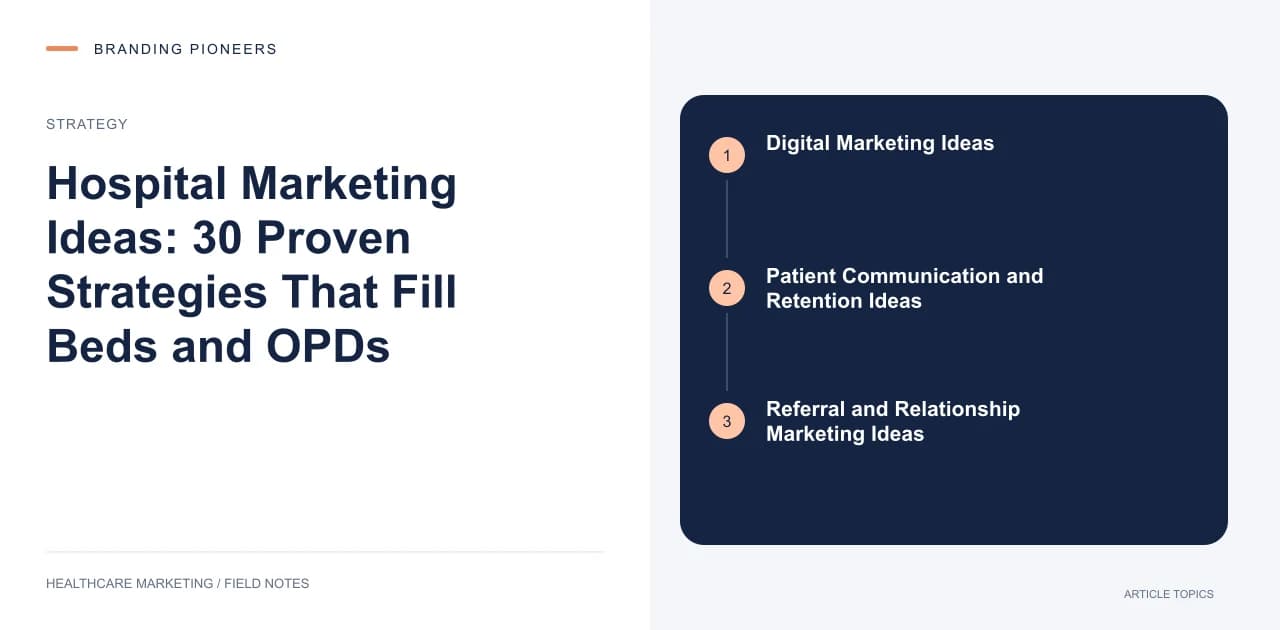
30 hospital marketing ideas, each grounded in what actually works in Indian healthcare marketing. No filler, no theory — just practical tactics.
Digital Marketing Ideas
1. Build individual doctor profile pages that are 800+ words. The best doctor pages can get thousands of monthly visits each and rank for 50–100 keywords. Most hospitals have 100-word doctor bios. The gap is your opportunity.
2. Create procedure-specific landing pages for every high-value service. A dedicated page for "knee replacement surgery in [city]" converts far better than a generic orthopaedics department page. For a hospital doing ₹10 lakh/month in Google Ads, that difference alone can be worth several lakh in additional patients monthly.
3. Run Google Ads with exact-match keywords only for your top 5 specialties. Broad match wastes budget. Switching to exact and phrase match on high-intent keywords typically reduces wasted spend and increases conversions at the same time.
4. Add a floating WhatsApp button to every page of your website. Many visitors who don't fill a form will message on WhatsApp if the option is visible. It costs ₹0 to add the button.
5. Build a remarketing campaign for people who visited your booking page but didn't convert. These high-intent visitors convert at a far higher rate than cold traffic when shown reminder ads, at a noticeably lower cost. This is one of the highest-ROI PPC tactics available to hospitals.
6. Make feedback easy for every patient — and keep doctors out of review requests. NMC's guidelines of 6 October 2026 say a doctor shall not request or share patient reviews for professional promotion on social media (Expl. V to para 3.2), and asking only the patients who seem happy is review gating, which Google's policies prohibit. Instead, give every patient the same discharge card with the hospital's feedback link and Google profile, offer no incentive, and reply to every review politely without mentioning any patient detail. See our NMC guide for the full rules.
7. Post 1 educational Reel per week from each specialist. A 60-second video of a doctor explaining one common symptom or misconception. No production budget needed. A phone, decent lighting, and 10 minutes per week. End each one with the doctor's name, qualifications and SMR/NMR registration number, as NMC's 2026 guidelines expect on every post (Expl. III to para 3.2), and keep it educational, with no booking pitch. Doctors with active Reels programs tend to see meaningfully more self-referred consultations.
8. Film one 8–12 minute YouTube video per specialty per month. YouTube videos rank in both YouTube and Google search. A well-made video titled "Knee replacement surgery: what to expect from day 1 to day 90" from an orthopaedic surgeon can accumulate well over 100,000 views. Estimated referral value: significant.
9. Create a free downloadable health guide for each specialty. "Complete Guide to Managing Type 2 Diabetes" gated behind an email/WhatsApp opt-in. This builds a list of people interested in your endocrinology department. Hospitals that do this well can build a large list of opted-in diabetic patients and convert a meaningful share to consultations over time.
10. Publish a monthly content calendar tied to patient search behavior, not marketing events. Research what your patients are searching for in Google (use Google's autocomplete and "People Also Ask") and create content that answers those specific questions.
Patient Communication and Retention Ideas
11. WhatsApp appointment reminder at 72 hours, 24 hours, and 2 hours. Cardiac programs that adopt 3-stage WhatsApp reminders typically see no-show rates drop sharply — at scale, that frees up appointment slots that would otherwise go empty.
12. Call every patient within 24 hours of their OPD visit. "Just checking how you're feeling after your appointment today." This takes 2 minutes per patient and meaningfully increases the probability of a return visit.
13. Build a screening-reminder programme. A WhatsApp or SMS message, to patients who have opted in, when a check-up their doctor recommended falls due. Costs nothing except time to configure the automation. Skip the free-check-up vouchers that used to ride along with birthday messages: NMC's 2026 guidelines bar free procedures and similar inducements (para 8.1(x)).
14. Create a "15-month visit" alert in your CRM. Any patient who hasn't visited in 15 months gets an automated reactivation message. Hospital chains that implement this can generate substantial additional revenue in the first quarter alone from previously inactive patients.
15. Schedule follow-up appointments before the patient leaves. Don't let patients walk out without their next appointment booked. Post-procedure follow-ups should be scheduled at discharge. Annual checkups should be scheduled at the end of the current visit.
Referral and Relationship Marketing Ideas
16. Launch a structured GP referral program. Primary care doctors are your single best referral source for specialist procedures. Most hospitals don't systematically cultivate these relationships. A monthly newsletter for GPs in your catchment area, a WhatsApp group for clinical updates, and quarterly in-person sessions build lasting referral networks. Keep it purely clinical: no referral fees, commissions or gifts of any kind (NMC 2026 guidelines, para 8.1(vii)).
A structured gynecologist outreach program — monthly clinical updates, exclusive access to specialists for complicated cases, and a dedicated referral coordinator — can grow maternal care referrals substantially within a year.
17. Give patients something worth passing on. Patients already tell their families where they were treated. Make that easy with take-home health-education leaflets and a clear contact card, which NMC's guidelines expressly permit (para 8.2(iv)). Don't reward referrals: priority access, free check-ups or other referral benefits count as inducements under para 8.1(x).
18. Build a corporate wellness partnership program. Contact HR departments at companies in your catchment area. Offer employee health check packages, on-site health camps, and dedicated corporate booking channels. Corporate health packages build steady, predictable revenue independent of advertising cycles.
19. Partner with physiotherapists, dieticians, and alternative medicine practitioners. These practitioners see patients before they need hospital care and can refer when specialist intervention becomes necessary. Build relationships through quarterly educational sessions, easy referral pathways, and feedback loops.
20. Create a medical tourism package for specific procedures. Hospitals within 200 km of major international airports should be packaging elective procedures for medical tourists. NABH or JCI accreditation is table stakes. Add: dedicated international patient coordinator, accommodation partnerships, translation services, and travel support. A well-run international patient program can become a meaningful share of a hospital's total revenue.
Community and Brand-Building Ideas
21. Support public-health camps in underserved areas. Run them as public health, not patient acquisition. Camps tied to Government of India or state programmes are expressly exempt (NMC 2026 guidelines, para 7.3), and they build community goodwill. A free camp designed to funnel people into paid procedures, though, looks like the inducement and solicitation that para 8.1(x) prohibits, so refer only where there's a clinical need and keep sales follow-up out of it.
22. Host monthly free health talks at residential societies and corporate offices. A 45-minute talk by one of your specialists on a relevant topic (diabetes management, heart health, back pain prevention) builds personal trust. Keep it educational, with no booking pitch, as para 5.1 of NMC's guidelines requires. Speakers who do 2 talks/month typically see a noticeable rise in self-referred patients within 6 months.
23. Build a "Doctor's Corner" column in local newspapers. Weekly health Q&A from one of your specialists in the local language newspaper. Builds brand authority and generates calls from readers with similar concerns.
24. Get your doctors on regional news channels as health experts. Positioning your cardiologist as the local expert who comments on cardiac health news takes 1–2 interviews to establish. Once you're the go-to expert for the local TV station, you get continuous free brand building. One caution: NMC's guidelines allow such talks in the doctor's own name and designation, without promoting the employer (para 8.2(iii)), so the interview is about the health topic, not the hospital.
25. Create a newsletter for existing patients — not a promotion, a genuine health resource. Monthly email and WhatsApp newsletter with: one health tip, one explainer from a specialist, one new service update, one seasonal health advisory. Open rate benchmark for a well-curated healthcare newsletter: 35–45%.
Operational Marketing Ideas (Often Overlooked)
26. Measure and publish your wait times online. "Average OPD wait time: 18 minutes." This single data point, if honest and competitive, influences booking decisions significantly. Patients hate uncertainty. Telling them what to expect builds trust before they arrive.
27. Create a dedicated booking line for digital leads. Patients who came from digital advertising should not be going to the same general inquiry number as walk-ins and billing queries. A dedicated digital inquiry line with faster response and specialized coordinators can meaningfully improve conversion.
28. Film short "meet the team" videos for your front desk staff. Most patients are anxious about calling a hospital. A 30-second video of your front desk coordinator saying "Hi, I'm Priya, and I'll help you book your appointment" reduces anxiety and improves call-to-booking rates. Hospitals that test this typically see a solid improvement in call conversion.
29. Send a post-discharge patient satisfaction survey with a WhatsApp link. Don't wait for patients to leave negative reviews. Send a survey 48 hours post-discharge. Learn about problems before they become public complaints. Unhappy patients who feel heard rarely leave negative reviews.
30. Create department-specific pages on your website with pricing information. "How much does knee replacement cost?" is one of the top questions patients ask. Hospitals that publish honest pricing ranges (e.g., "₹2.8–₹4.5 lakh depending on implant type and room type") see higher trust and higher booking rates from patients who found them through that query.
Price transparency is still rare in Indian hospitals. Being one of the few who does it builds significant differentiation.
If you want help implementing any of these ideas — from WhatsApp automation to doctor content programs to referral marketing — talk to Branding Pioneers. We've executed these strategies with real hospital clients.
Filed underhospital marketing ideashealthcare marketing ideas Indiahospital marketing strategieshow to market a hospital

About the author
Nishu Sharma
Founder & CEO · Gurugram, India
Nishu founded Branding Pioneers in 2016 with one rule that hasn't changed since: healthcare only. She'd run digital strategy at a top-10 Indian agency and watched generalist marketing underserve medical clients who needed something built for how patients actually search and decide. So she left to build the specialist instead. It's now an 80-person team working with healthcare brands worldwide.
Free guide · 17 pages
The Patient Acquisition Blueprint
A 90-day plan from first search to booked appointment.