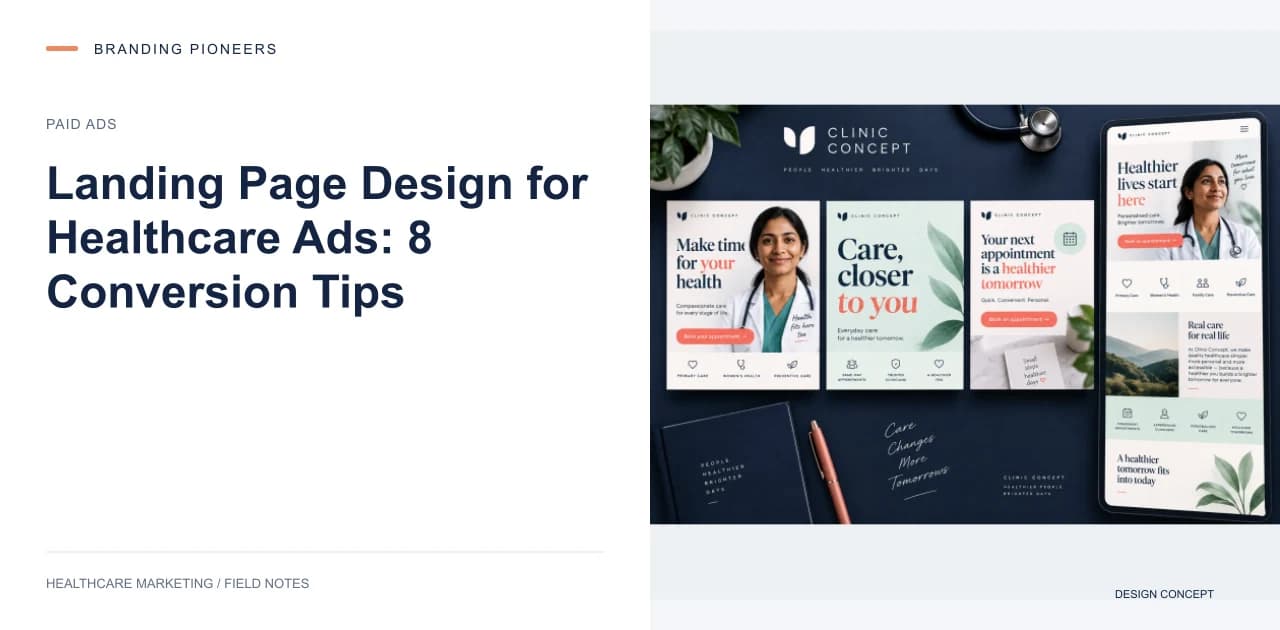
Landing Page Design for Healthcare Ads: 8 Conversion Tips
Your ad is only as good as the page it sends traffic to. Here are eight landing page principles that consistently increase healthcare ad conversion rates.
Sources & References
Your ad is only as good as the page it sends traffic to. Here are eight landing page principles that consistently increase healthcare ad conversion rates.
A well-optimized Google Ads campaign sending traffic to a poorly designed landing page is like hiring an excellent salesperson and locking them in a closet. The ad does its job — it gets the click. But the landing page decides whether that click becomes a patient.
We have tested hundreds of healthcare landing pages across dental, orthopedic, cosmetic surgery, and multi-specialty practices. These eight principles consistently separate pages that convert at 8 to 12 percent from pages that convert at 2 to 3 percent.
If your ad says "Same-Day Dental Implants Starting at 2,999 Dollars," the landing page headline must say the same thing. Not "Welcome to Our Dental Practice." Not "Comprehensive Implant Solutions." The exact same promise.
This is called message match, and it is the single biggest factor in landing page conversion. When the page headline matches the ad headline, the visitor immediately knows they are in the right place. Any disconnect — even a subtle one — triggers bounce.
A landing page is not a website. It has one purpose: get the visitor to take one specific action. For healthcare, that action is usually booking a consultation, calling the practice, or submitting a contact form.
Remove your main website navigation. Remove links to your blog, your about page, and your other services. Every link that does not lead to the conversion action is an exit opportunity. We consistently see 15 to 25 percent conversion improvements simply from removing the top navigation bar.
The top section of your landing page — visible without scrolling — needs four elements: a headline that matches the ad, a subheading that adds one key benefit, a trust signal (star rating, number of patients treated, or board certification badge), and a prominent call-to-action button.
The CTA button should use action-oriented, specific text. "Book My Free Consultation" outperforms "Submit" by 30 percent or more. "Call Now — Dr. Sharma Answers Personally" outperforms "Contact Us."
Patient testimonials should appear high on the page — within the first scroll or two. Use real patient names (with consent), photos if possible, and specific details about their experience. "Dr. Patel replaced both my knees and I was walking without a cane in six weeks" is infinitely more convincing than "Great doctor, highly recommend."
Include your Google review rating and review count. Display logos of hospitals you are affiliated with, insurance panels you participate in, and any awards or recognitions.
Every service has common patient hesitations. For dental implants, it might be cost, pain, and recovery time. For cosmetic surgery, it might be results, safety, and qualifications.
Identify your top three objections and address them explicitly on the landing page. Use a section like "Common Questions" or simply address them in your body copy. "Most patients report the procedure is less painful than a tooth extraction — we use local anesthesia and IV sedation for complete comfort."
Over 70 percent of healthcare ad clicks come from mobile devices. Your landing page must be designed for phones first, desktops second. That means large tap targets for buttons (at least 48 pixels tall), a click-to-call phone number, a short form (name, phone, preferred time — nothing more), and fast load speed (under three seconds on mobile networks).
Test your landing page on an actual phone, not just a desktop browser resized. The experience is different.
Every additional second of load time reduces conversion by 7 percent. A page that loads in five seconds converts 21 percent less than a page that loads in two seconds.
For healthcare landing pages, the most impactful speed improvements are compressing hero images (use WebP format), lazy-loading below-the-fold content, minimizing JavaScript, and using a CDN. Google PageSpeed Insights will identify your specific bottlenecks.
Not every visitor is ready to book immediately. Offer a primary CTA (book a consultation), a secondary CTA (call the office), and a tertiary option (download a guide or watch a video). The tertiary option captures information from earlier-stage visitors so you can follow up.
A downloadable guide like "5 Questions to Ask Before Knee Replacement" captures an email address from someone not yet ready to call. Your email nurture sequence then moves them toward booking over the following two to four weeks.
Build a baseline, then test one element at a time. Headline variations often produce the largest conversion differences. Test three to four headlines over two to four weeks before moving to other elements. Use Google Optimize or a similar tool to run proper A/B tests rather than making changes and guessing.
Writing on healthcare growth, AI-powered patient acquisition, and the operational reality of marketing inside hospitals and clinics.
The exact 90-day patient-acquisition system, step by step.
After auditing 300+ healthcare Google Ads accounts, these are the ten most common and costly mistakes we see. Each one i…
Local Service Ads appear above regular Google Ads and you only pay for actual leads. Here is how to set them up for your…
Healthcare keywords are among the most expensive in Google Ads. Here are proven tactics to cut your cost per click witho…
Six reasons hospitals, clinics, and doctors pick a healthcare-only firm over a generalist agency.
It's all we do. No retail, no fintech — the whole team thinks in patient journeys, clinical trust, and the way people actually choose a doctor.
Receptionists, WhatsApp triage, and attribution built in-house — we answer patients in seconds and tie every click to a booked appointment.
HIPAA, ASCI, NABH and GDPR sign-off baked into every campaign — our standard, not an upcharge or an afterthought.
The senior who pitched you stays on the engagement. No bait-and-switch to juniors learning on your budget.
Patient-level attribution across calls, forms, and walk-ins. Monthly reports show booked patients — not just clicks and impressions.
We name our clients and show the work. Quarterly reviews with the numbers attached, every cycle.
Adjacent practices, the relevant tools, and the case files where we shipped this thinking against real patient-acquisition targets.