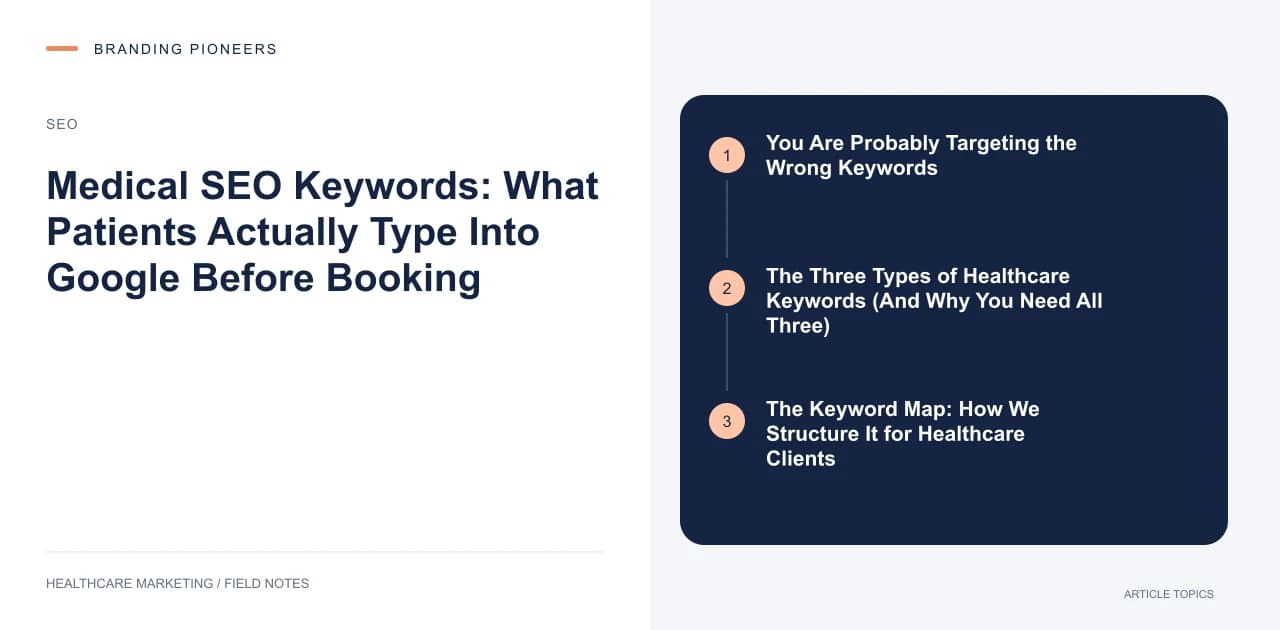
You Are Probably Targeting the Wrong Keywords
Here is a pattern we see in almost every healthcare SEO audit: the hospital wants to rank for "best orthopedic hospital in Delhi." Their content team writes pages targeting that exact phrase. And they wonder why the traffic trickles in.
The problem is not effort. It is aim.
"Best orthopedic hospital in Delhi" gets roughly 1,200 searches per month. That sounds good until you realize that "knee pain when climbing stairs" gets 8,100 searches per month. "ACL tear recovery time" gets 6,600. "Knee replacement cost in India" gets 4,400.
Those are your patients. Not the ones who already know they need a hospital — the ones who are still figuring out what is wrong and what to do about it. If you are not showing up for those searches, someone else is capturing them.
We have done keyword research for hundreds of healthcare websites across 30+ medical specialties. The patterns are remarkably consistent, and most hospitals get them wrong in the same ways.
The Three Types of Healthcare Keywords (And Why You Need All Three)
1. Symptom Keywords (Awareness Stage)
These are how patients start their search. Not with your hospital name. Not with a procedure name. With their pain.
"Sharp pain under left rib cage" "Bleeding gums every morning" "Blurry vision in one eye" "Lump in neck that moves"
These keywords have massive volume. They also have lower conversion rates because the patient is early in their journey. But here is what most healthcare marketers miss: the hospital that answers the symptom query is the hospital the patient remembers when they are ready to book.
Think about it from the patient's perspective. You search "sharp pain in knee when bending." You find an article on Hospital A's website that explains the five most common causes, tells you when to see a doctor, and has a link to book a consultation. Three weeks later, when the pain has not gone away and you decide to see an orthopedic surgeon, which hospital comes to mind?
Hospital A. Every time.
How to find symptom keywords for your specialties:
Pull your Google Search Console data and filter for queries containing words like: pain, symptoms, causes, why, bleeding, lump, swelling, numbness, when to see a doctor.
Use Google's "People Also Ask" boxes for your primary services. Search "knee replacement" and note every question Google suggests. Those questions are your patient's actual search behavior.
Check Quora and Reddit for threads about conditions you treat. The language patients use is different from the language doctors use. "Heart palpitations after eating" is not a clinical term, but patients search for it 12,000 times per month.
2. Treatment and Procedure Keywords (Consideration Stage)
Once the patient knows (or suspects) what they have, they research solutions.
"Knee replacement surgery recovery time" "Invisalign vs braces for adults" "LASIK surgery side effects" "IVF success rate by age" "Root canal procedure what to expect"
These keywords have strong commercial intent. The patient is actively evaluating whether to pursue treatment. Your content for these terms needs to be comprehensive, honest, and specific.
What works for treatment keyword content:
Answer the core question in the first paragraph. Do not bury it under three paragraphs of introduction. If someone searches "how long is knee replacement recovery," tell them "4 to 6 weeks for basic mobility, 3 to 6 months for full recovery" in the first two sentences. Then elaborate.
Include specifics that other sites skip. Recovery timelines by age group. Cost ranges with insurance considerations. Success rates with real data. Comparison with alternative treatments. Your physicians have this knowledge — extract it and publish it.
Add a clear "next step" CTA. The patient reading about knee replacement recovery is considering the procedure. "Want to know if knee replacement is right for you? Book a free assessment with our orthopedic team" is not pushy — it is helpful.
3. Provider Keywords (Decision Stage)
The patient has decided to pursue treatment. Now they are choosing who to trust with it.
"Best knee replacement doctor in Gurgaon" "Top IVF clinic Delhi NCR reviews" "Apollo vs Fortis orthopedic surgery" "Dr. [Name] reviews" "[Hospital name] knee replacement cost"
These keywords have the highest conversion rate and the highest competition. Every hospital wants to rank for "best [specialty] in [city]."
How to win provider keywords:
Do not write a page that says "We are the best orthopedic hospital in Delhi" ten times. Google is smarter than that, and patients find it obnoxious.
Instead, build the evidence that supports the claim:
- Doctor profile pages with credentials, experience, and patient reviews
- Case study pages with real patient outcomes (anonymized, with consent)
- Comparison content that honestly evaluates options ("How to choose an orthopedic surgeon — what to look for")
- Review aggregation that pulls your best Google, Practo, and Healthgrades reviews onto your site
The hospital that ranks for "best orthopedic surgeon in Delhi" is usually not the one that targets that keyword directly. It is the one with the strongest E-E-A-T signals, the most detailed doctor profiles, the freshest reviews, and the most comprehensive service content.
The Keyword Map: How We Structure It for Healthcare Clients
For every medical specialty a hospital offers, we build a keyword map with four layers:
| Layer | Example (Orthopedics) | Search Volume | Content Type |
|---|---|---|---|
| Symptom | knee pain when climbing stairs | 8,100 | Blog post |
| Condition | torn ACL symptoms | 5,400 | Condition page |
| Treatment | ACL reconstruction surgery recovery | 3,600 | Treatment guide |
| Provider | best orthopedic surgeon Gurgaon | 1,200 | Service + doctor page |
Each layer feeds the next. A patient finds your symptom blog post, clicks through to your condition page, reads your treatment guide, and lands on your doctor's profile page with a booking button.
This is not a funnel on a whiteboard. This is a funnel built into your website architecture, with internal links connecting every stage.