The Problem With Being Everywhere
Expanding to multiple locations is a healthcare business milestone. It is also the moment when marketing breaks.
We have worked with hospital chains running 3 to 50 locations across India — mother-and-child hospital groups, multi-city cardiac care networks, pediatric chains, and dozens of smaller regional chains. The marketing challenges that emerge at 5 locations are different from 1, and different again at 20.
The most common multi-location marketing failures:
Duplicate content problems. Every location page says the same thing with just the city name swapped. Google recognizes this as near-duplicate content, penalizes the pages, and none of them rank.
SEO cannibalization. Your Delhi Saket location and your Delhi Dwarka location are both trying to rank for "pediatric hospital Delhi," effectively competing against each other.
Brand consistency breakdown. Location-level marketing teams post whatever they feel like on social media, respond to reviews in inconsistent voices, and run promotions that conflict with the brand's premium positioning.
Budget dilution. Marketing spend spread thin across 15 locations produces mediocre results at all 15, instead of dominant results at the 5 locations with the highest patient potential.
The fix for all of these is architecture: a systematic structure that makes multi-location marketing a multiplier instead of a management nightmare.
The SEO Architecture for Hospital Chains
The Hub and Spoke Model
Think of your corporate website as the hub. Each location page is a spoke.
The hub — your main domain (e.g., cloudnine.in or rainbowchildrens.in) — ranks for broad brand and specialty terms: "pediatric hospital India," "best children's hospital," "Rainbow Children's hospital review."
Each spoke — location-specific pages (cloudnine.in/hospitals/delhi, cloudnine.in/hospitals/bangalore) — ranks for local terms: "pediatric hospital in Delhi," "best children's hospital Bangalore," "Rainbow Bannerghatta Road."
The architecture failure most chains make: they build the hub well but make the spokes identical thin pages. Google sees these as duplicates and ranks none of them.
What a proper spoke page requires:
- Unique, location-specific content of at least 800 words — not just "our Delhi location offers the same services as all our hospitals." What makes the Delhi location specifically relevant? Which doctors are on staff (and their actual names, qualifications, and specialties)? What is the address and what are the nearest landmarks? Which insurance networks are accepted at this specific location? What procedures are available at this location but not others?
- Location-specific FAQ content. "What are the visiting hours at Cloudnine Malad?" Different from every other location page.
- Embedded Google Maps with the specific location.
- Local schema markup: LocalBusiness schema (or MedicalClinic schema) with the specific address, phone, hours, and geo-coordinates of that branch.
- Reviews specific to that location, pulled from the location's Google reviews (not aggregate reviews across all branches).
- Photos specific to that location — not stock or shared photos from the flagship location.
Internal Linking Strategy
Each location page should link to:
- The specialty service pages on the main site (linking spoke to hub)
- Nearby location pages (for large cities with multiple branches)
- Doctor profile pages for doctors at that location
The hub should link to all location pages from a clearly organized "Our Locations" page with proper schema markup.
This internal link structure passes authority between hub and spokes, reinforces the site architecture to Google, and helps patients navigate between the central brand and their specific local option.
Subdomain vs Subfolder — What Actually Works
The perennial SEO debate for multi-location sites: should each location be delhi.hospitalname.com (subdomain) or hospitalname.com/delhi (subfolder)?
The answer is subfolder, almost always. Subfolders inherit the domain authority of the main domain. Subdomains are treated more like independent sites and have to build their own authority from scratch.
The only exception: when different locations are genuinely different businesses with different branding (different name, different specialties). In that case, separate domains or subdomains can make sense. For a unified hospital brand, use subfolders.
Google Business Profile Management at Scale
A chain with 20 locations has 20 Google Business Profiles. Managing these consistently is a full-time job without a system.
The central management approach:
Use a GBP management platform — BrightLocal, Yext, or Google's own Google My Business API — to push updates to all locations simultaneously. When your holiday hours change, one update propagates to all 20 profiles. When you have a chain-wide promotion, one post goes to all locations.
The local response approach:
Reviews must be responded to locally, not centrally. A response that says "Thank you for visiting our facility" sounds like a robot. The response should reference the specific location, ideally the specific doctor or department, and the specific concern raised.
Assign a local staff member (typically the patient relations or front desk manager) to own Google review responses at each location, with a brand voice guide and response template framework.
Consistency minimums across all GBP profiles:
- Same primary category and secondary categories across all locations
- Same service list (with location-specific additions where applicable)
- Same Q&A responses to the most common questions (What is your visiting policy? Do you accept [insurance]?)
- Same description framework, customized with location-specific content
- Photos updated at each location monthly
Branding Consistency at Scale
The Brand Standard Document
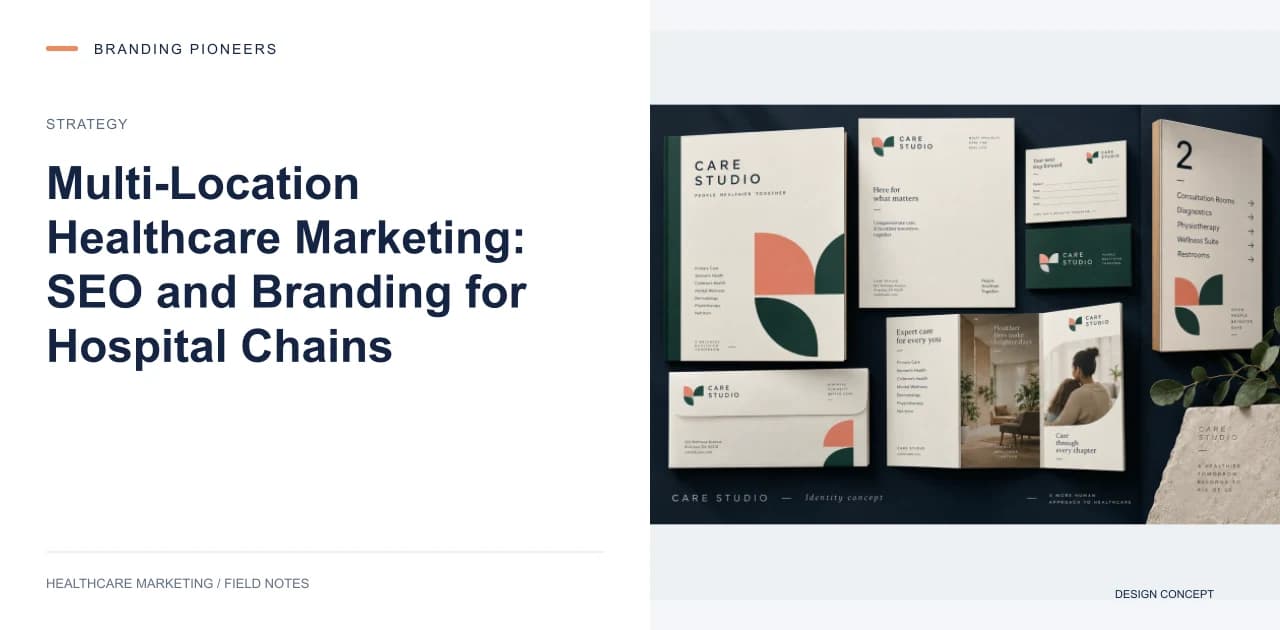
Every multi-location brand needs a living document that answers the question: what does our brand look like, sound like, and act like?
For hospital chains, this includes:
Visual standards: Logo usage, colors, typography, approved photo styles, social media post templates.
Voice standards: How do we talk to patients? Are we warm and friendly (Cloudnine's mother-first tone) or authoritative and clinical (some specialty chain tones)? What words do we avoid? How formal are our captions?
Social media standards: What can local teams post independently vs what requires central approval? What response templates exist for common review types?
Promotional standards: What can local teams publish without central approval, and what requires sign-off? For Indian hospitals the answer now starts from the NMC's 6 October 2026 guidelines: no discounts, free procedures, superlatives or patient testimonials at any location (paras 8.1(iii), (ix), (x); Explanation V to para 3.2), and every post naming a doctor carries their qualifications and registration number. See our NMC guide.
Without this document, your 20 social media managers across 20 locations create 20 different interpretations of your brand.
Centralized Creative With Local Customization
The most efficient creative model for hospital chains: centralized design production with a localization layer.
The central marketing team creates templates: Instagram post templates, Facebook cover photo templates, print templates for local newspaper ads. Local teams fill in location-specific details (doctor name and registration details, local health-awareness event, new department or equipment) within the template structure.
This gives local marketing the flexibility to be locally relevant while preventing brand drift. The branding stays consistent. The content is locally meaningful.
Budget Allocation Across Locations
The most common mistake: equal distribution. Every location gets the same marketing budget.
This is almost never the right answer. Location performance varies enormously by local competitive intensity, patient population size, and growth potential.
A rational budget allocation framework:
30 percent of budget: Brand-level (hub) — SEO for brand terms, brand awareness social media, thought leadership content, PR.
50 percent of budget: Performance-allocated — Distributed based on location revenue potential and marketing ROI. High-potential locations get more. Locations that have hit market saturation get less.
20 percent of budget: Experimental — Testing new channels, new messaging, new locations. What works in the experimental pool gets scaled.
For a chain with ₹50 lakh/month marketing budget across 15 locations: ₹15 lakh on brand, ₹25 lakh performance-allocated across locations based on ROI data, ₹10 lakh experimental.
Build Your Hospital Chain's Marketing Architecture — Let's Talk →
Filed undermulti-location healthcare marketinghospital chain marketingmulti-location hospital SEOhealthcare brand consistencyhospital group digital marketing

About the author
Nishu Sharma
Founder & CEO · Gurugram, India
Nishu founded Branding Pioneers in 2016 with one rule that hasn't changed since: healthcare only. She'd run digital strategy at a top-10 Indian agency and watched generalist marketing underserve medical clients who needed something built for how patients actually search and decide. So she left to build the specialist instead. It's now an 80-person team working with healthcare brands worldwide.
Free guide · 17 pages
The Patient Acquisition Blueprint
A 90-day plan from first search to booked appointment.