Here's a number most hospital CMOs don't track: patient retention rate.
Ask a CFO what their patient acquisition cost is and they'll tell you ₹3,500 or ₹5,000 or ₹8,000. Ask them what percentage of patients return for their second visit — and most won't know.
A large share of patients never return after their first visit — which means a similarly large share of your acquisition spend is going toward patients who immediately walk out.
Acquiring a new patient typically costs substantially more than retaining an existing one, and even a modest increase in patient retention can meaningfully boost profitability.
Yet when we audit hospital marketing budgets, we consistently find the large majority of spend going to acquisition. Retention is an afterthought — a department head's responsibility, not a marketing investment.
This is backwards.
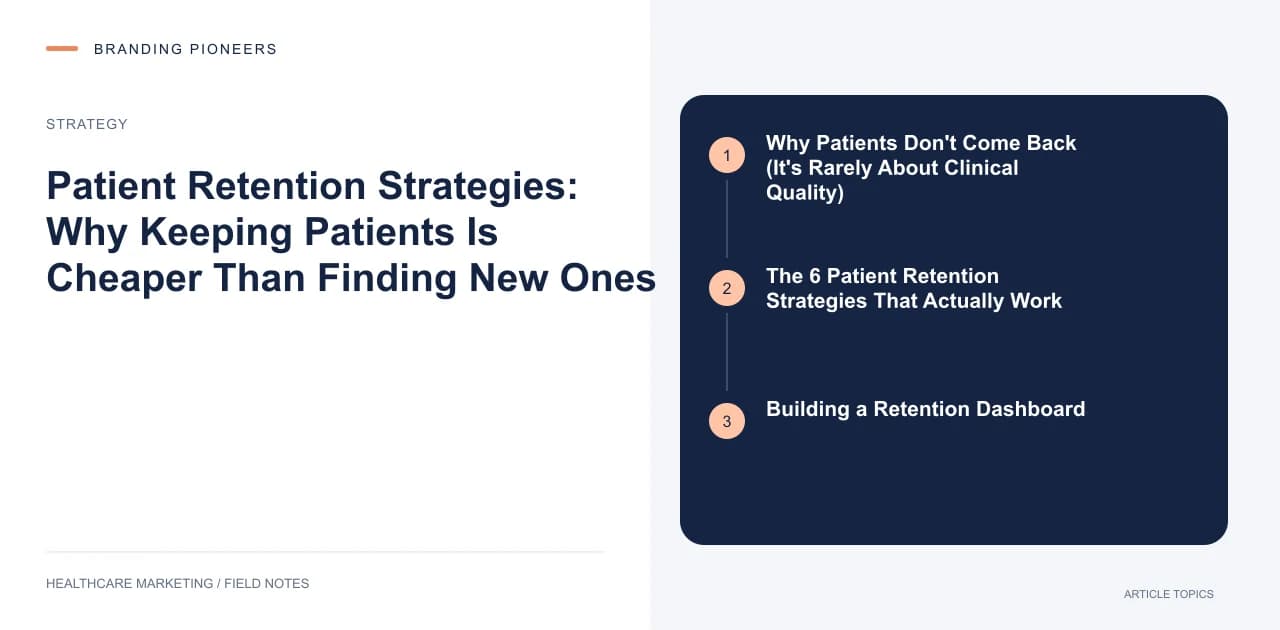
Why Patients Don't Come Back (It's Rarely About Clinical Quality)
Patients who don't return for follow-up or subsequent care after an elective or non-emergency procedure tend to cite the same handful of reasons:
- "Nobody followed up after my procedure" — the most common reason by far
- "I forgot about them / didn't think of them first" — a close second
- "Booking was inconvenient"
- "I found another hospital closer to my new home/workplace"
- "I had a bad experience with staff (not clinical)" — the least common reason
Clinical quality is almost never cited as a reason for leaving. The top two reasons — no follow-up and forgetting — are almost entirely preventable with a basic communication system.
The 6 Patient Retention Strategies That Actually Work
Strategy 1: Post-Visit Follow-Up Within 24 Hours
This is the single highest-impact action in patient retention. Call, WhatsApp, or email every patient within 24 hours of their visit. Not to sell anything — just to check in.
"Hello Mr. Sharma, this is the team from Max Healthcare. We wanted to check how you're feeling after your consultation with Dr. Gupta yesterday. Do you have any questions or concerns?"
This single action meaningfully increases the likelihood of a return visit.
At scale, this is automated via WhatsApp: "Hello {{Name}}, thank you for visiting Max Healthcare. We hope your consultation was helpful. If you have any questions for Dr. {{Doctor Name}}, please reply here or call us."
Strategy 2: Scheduled Follow-Up Appointments Before They Leave
Don't let patients leave without a next appointment already booked. Post-procedure follow-ups should be scheduled before the patient is discharged. Annual health checkup appointments should be booked at the conclusion of the current visit.
"We'd like to schedule your 6-week post-operative follow-up before you leave today. What date works for you?"
Hospitals that implement this protocol across a cardiac care program often see the no-show rate at the 6-week follow-up drop sharply, with patient retention for subsequent cardiac care improving substantially over time.
Strategy 3: Annual Health Checkup Reminders
If someone came to your hospital for any reason, they are a potential annual checkup patient. Build an automated reminder program:
- 11 months after last visit: "It's almost been a year since your visit to [Hospital]. Are you due for your annual health check?"
- 12 months after last visit: "Your annual health check is overdue. The package costs ₹[X] and includes [tests]." (No time-limited discount: NMC's 2026 guidelines bar limited-period offers and discounts for hospitals as well as doctors, para 8.1(x).)
- 13 months after: Final reminder with a soft urgency message.
Programs like this can add substantial monthly health checkup revenue from existing patients alone — with no new acquisition spend required.
Strategy 4: Condition-Specific Education Programs
Patients with chronic conditions — diabetes, hypertension, cardiac disease, PCOS — need regular engagement. Build condition-specific content programs that deliver value to these patients regularly.
A diabetic patient who receives monthly WhatsApp messages from your hospital's endocrinology team — blood sugar management tips, seasonal food guidance, new research summaries — is far more likely to return to you for specialist care than to the anonymous specialist they found on Practo.
A well-run diabetes management WhatsApp program can build a large base of opted-in patients, with engagement and annual checkup booking rates from that list running far above the industry average.
Strategy 5: Loyalty and Recognition Programs
Healthcare loyalty programs in India are underdeveloped compared to retail. Most hospitals don't have any structured recognition program. This is a missed opportunity.
The most effective healthcare loyalty mechanisms are not "points" systems (which feel transactional). They are recognition and access:
- Priority appointment slots for returning patients
- Dedicated patient coordinators who know your history
- Access to specialist consultations that new patients must wait weeks for
- A published fee schedule for follow-up visits, so returning patients know what to expect
- Reminders when a screening their doctor recommended falls due
(Screening discounts and "free check-up after five visits" rewards were common loyalty tools, but NMC's 2026 guidelines bar discounts, free procedures and similar inducements for hospitals as well as doctors (para 8.1(x)).)
The psychological principle: make returning patients feel like insiders, not just customers. Named patient coordinators, remembering preferences, personalized communication — these cost almost nothing and create powerful retention.
Strategy 6: Making It Genuinely Easier to Come Back
The #3 reason patients don't return: inconvenience. Fix the friction.
What this means practically:
- Save patient records so they never have to fill in registration forms again
- Remember their preferred communication channel (WhatsApp vs call vs email)
- Send appointment reminders 72 hours, 24 hours, and 2 hours before visits
- Offer a dedicated returning-patient booking line with shorter wait times
- Allow online rescheduling without calling
These sound like basic service standards. Most hospitals still don't have them.