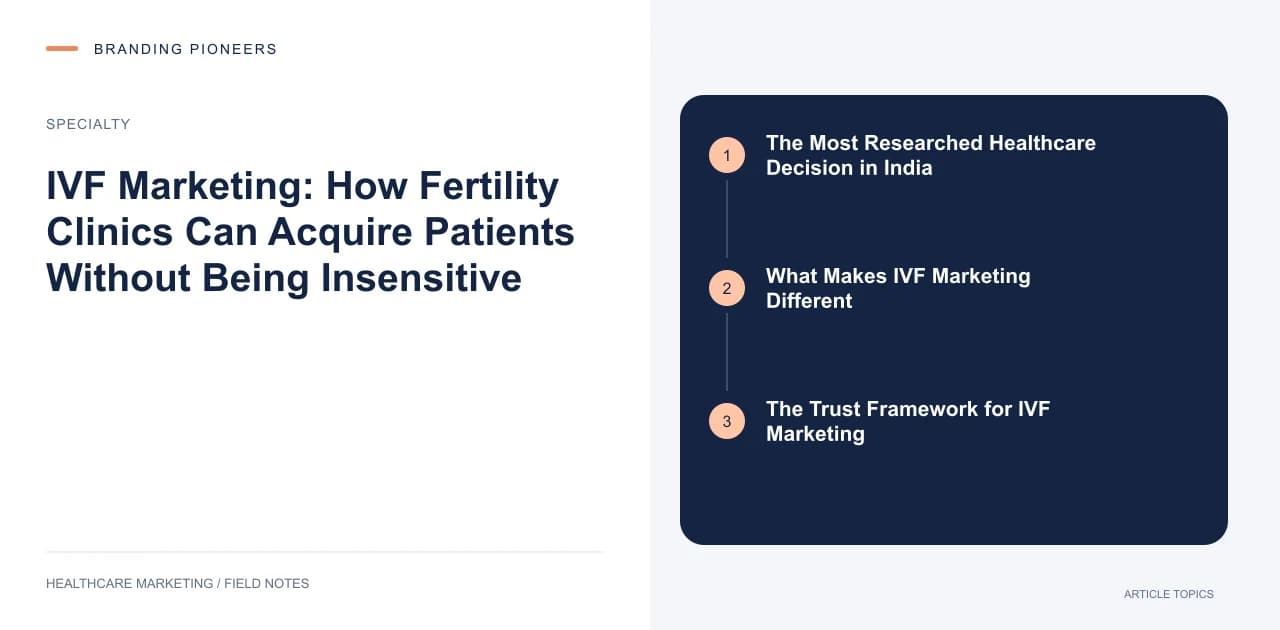
The Most Researched Healthcare Decision in India
Before a couple books their first IVF consultation, they spend an average of 4.2 months researching online. They read Reddit threads at midnight. They watch YouTube videos of other couples' journeys. They check success rates on three clinics' websites. They ask questions in fertility Facebook groups.
By the time they call you, they know more about blastocyst transfer and Day 5 embryo grading than most general practitioners do.
This is the IVF patient. Deeply researched, emotionally exhausted, financially stretched — IVF costs ₹1.5 to ₹3 lakh per cycle in India — and extraordinarily sensitive to anything that feels sales-y, dismissive, or tone-deaf.
Marketing to this patient requires a fundamentally different approach than marketing for dental whitening or orthopaedic consultations.
What Makes IVF Marketing Different
The decision timeline is long. Average 4 to 8 months from first web search to first appointment. You need to maintain visibility and trust across this entire window, not just at the point of intent.
The emotional stakes are extreme. Failed cycles, miscarriages, years of trying. Your marketing cannot feel like you are exploiting someone's pain.
Success rate claims invite scrutiny. "70% success rate" — success by whose definition? Fresh cycles? Frozen? All ages? Per embryo transfer? Clinics that publish honest, methodology-explained success data build more trust than those that headline a cherry-picked number.
Couples research together. Both partners see your content. Your messaging should acknowledge both.
Cost is a barrier but not the only one. Patients fear failure as much as they fear the cost. Address both explicitly.
The Trust Framework for IVF Marketing
Before any tactic, internalize this framework: every piece of content, every ad, every page should do one of three things:
- Reduce fear (demystify the process, normalize the journey)
- Build credibility (doctor expertise, clinical outcomes, accreditation)
- Respect the emotion (acknowledge the difficulty without exploiting it)
Anything that does not serve one of these three purposes does not belong in your IVF marketing.
Website: The Hub of Your IVF Patient Journey
Success Rates — Done Right
Do not just post "65% success rate." Post a full explanation:
- Success rate per cycle started (industry standard metric)
- Success rate by age bracket (under 35, 35-37, 38-40, 40-42, 42+)
- Success rate breakdown: fresh transfers vs frozen embryo transfers
- Definition of success (clinical pregnancy vs live birth vs ongoing pregnancy)
- How your data was collected and the time period it covers
Nova IVF Fertility publishes outcome data this way. It converts better than vague claims because it signals confidence and honesty.
Doctor Pages That Build Personal Trust
The embryologist and gynaecologist pages should include: formal credentials, specialized training (fellowship in reproductive medicine?), years of experience specifically in IVF, number of IVF cycles performed, philosophy of care, and a genuine first-person message.
Avoid stock photography. Real photos of doctors in the clinical setting. Real quotes, not corporate boilerplate.
A Dedicated FAQ Section
IVF patients have hundreds of questions. "Can I exercise during IVF stimulation?" "How many eggs are needed for a good success rate?" "What is the difference between IUI and IVF?" "Is donor egg IVF right for us?"
A comprehensive FAQ section does triple duty: answers patient questions, reduces staff call volume for pre-consultation queries, and ranks for long-tail keywords. Fertility clinics that build out FAQ-type content this way often see significant organic traffic from it.
Cost Transparency
Publish a cost range, not a "price on request." Patients who cannot find pricing feel the clinic is hiding something. A page that says "IVF at our clinic starts at ₹1.6 lakh for a fresh cycle, with frozen embryo transfers from ₹40,000. Medications typically add ₹30,000 to ₹60,000. Here is what is and is not included" builds more trust than a call-to-find-out approach.
Content Marketing: The Long Game
Couples' Journey Stories (With Full Consent)
A real story — anonymized or fully named with consent — of a couple who tried for 3 years, did two failed cycles elsewhere, came to your clinic, and had a successful pregnancy. Written with emotional honesty, not marketing gloss. These posts generate more organic search traffic, more time-on-page, and more consultation bookings than any procedural content.
Educational Video Series
"IVF explained in 5 minutes — what actually happens to your eggs and embryos." "Frozen embryo transfer vs fresh cycle — when do we recommend each?" "Male factor infertility — the conversation couples avoid." Short, clinical, doctor-delivered videos on YouTube build authority and rank on Google. We have seen these videos generate consultation bookings 18 months after posting.
Blog Topics That Rank and Convert
- "IVF success rates in India — how to read clinic data honestly"
- "Second opinion before IVF — when and how to get one"
- "IVF after 40 — what the data actually says"
- "PCOS and IVF — the protocol differences that matter"
- "Donor egg IVF in India — legal, ethical, and practical guide"
- "How to choose an IVF clinic — 12 questions to ask before you sign"
These rank for high-intent, lower-competition keywords and attract patients deep in the decision process.