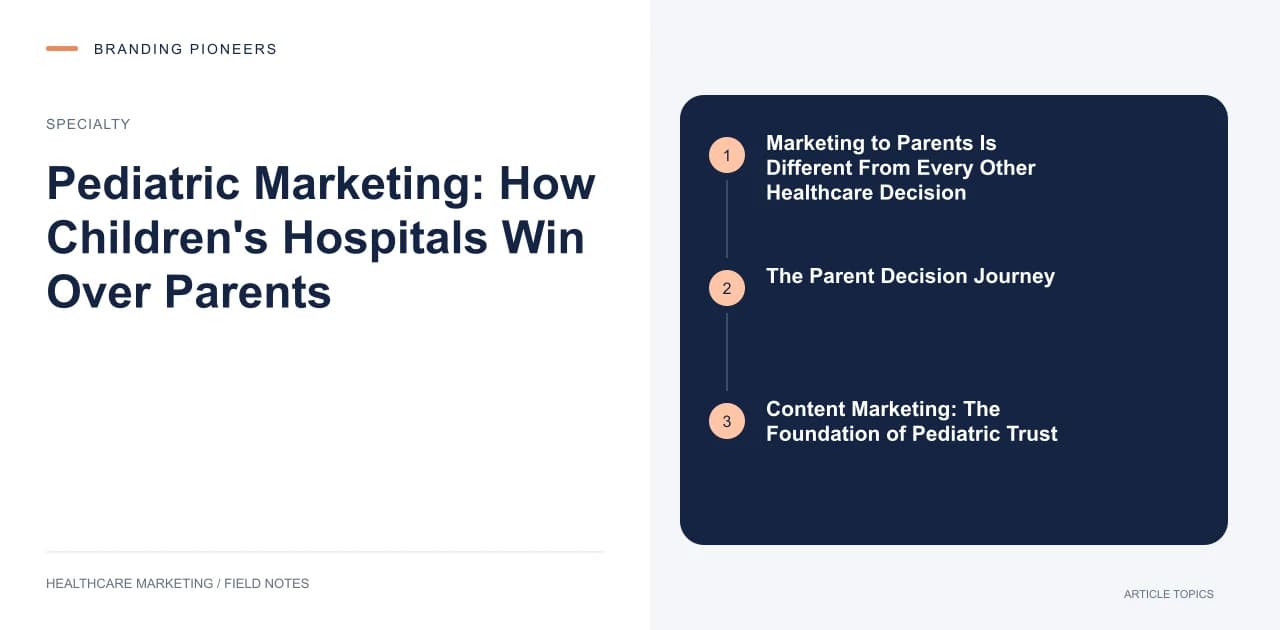
Marketing to Parents Is Different From Every Other Healthcare Decision
A 34-year-old mother researching pediatricians for her 8-month-old is not making a decision for herself. She is making a decision for someone she would do anything to protect. The stakes are extraordinarily high. The emotional state is heightened. The tolerance for anything that feels sales-y, corporate, or uncaring is essentially zero.
Pediatric marketing requires more authenticity, more warmth, and more genuine clinical communication than almost any other healthcare specialty. The good news: when you get it right, the loyalty is extraordinary. Families who trust their child's doctor refer every new parent they know, stay for years, and return through multiple children.
A pediatric practice with 40 genuinely satisfied families generates 15 to 20 referrals per year through organic word of mouth. Build that trust base through 5 years and your appointment book fills itself.
The Parent Decision Journey
Understanding the decision journey maps your marketing priorities.
First-time parent before birth (prenatal): Researching pediatricians before the baby arrives. "Best pediatrician near me," "how to choose a pediatrician," "neonatal care hospital." This is the highest-value acquisition window. A family that chooses you before birth stays for 15 to 18 years.
New parent (0-12 months): High anxiety, high search frequency, high receptiveness to expert guidance. Common searches: "baby not sleeping," "when does teething start," "newborn weight gain guide," "6-week vaccination schedule India." This parent is searching constantly and will follow the source that consistently gives reliable, accessible information.
Established parent (1-5 years): Regular well-child visits, illness management, vaccination, nutrition, development. Primarily loyal to their existing pediatrician. Switches happen due to poor experience or relocation.
School-age parent (5-12 years): Lower visit frequency. Seeks specialist input for ADHD, speech, learning disabilities, allergies, orthopaedic concerns.
Adolescent parent (12-18 years): Mental health, sports injuries, reproductive health. Often researches separately from primary pediatrician.
Your marketing must reach parents at each stage with relevant content.
Content Marketing: The Foundation of Pediatric Trust
Parent Education Content Library
The single most effective pediatric marketing investment is a genuinely useful content library for parents. Not keyword-stuffed articles that answer nothing, but real, specific, pediatrician-authored guidance.
Topics by age:
Newborn and infant (0-12 months):
- "Your newborn's first 72 hours — what is normal"
- "Breastfeeding and formula supplementation — a pediatrician's guide"
- "The 0-12 month vaccination schedule for Indian children — explained"
- "When fever in a newborn requires immediate attention"
- "Baby sleep safety — what Indian pediatricians actually recommend"
Toddler (1-3 years):
- "Picky eating in toddlers — what matters and what does not"
- "Screen time under 2 — the evidence and practical limits"
- "Speech development milestones and when to be concerned"
- "Fever management at home — when to call the doctor"
School age (4-12 years):
- "Signs of ADHD vs normal childhood energy — what to watch for"
- "Children and allergies in India — common triggers and testing"
- "Childhood asthma management — a parent's guide"
- "Nutrition for growing children — Indian diet considerations"
Adolescents (13-18 years):
- "Talking to your teenager about mental health"
- "Sports injuries in adolescents — when to see a specialist"
- "Adolescent nutrition and growth spurts"
This content library serves dual purposes: it ranks on Google for parent search queries (enormous volume) and it establishes your practice as the trusted expert these parents want guiding their child's health.
Video Content: The Pediatrician on Camera
Parents watching a pediatrician explain a concern in a calm, reassuring, knowledgeable way make an immediate trust judgment: "I would trust this doctor with my child."
YouTube content that works:
- "Is my child sick enough to need the doctor? A pediatrician's guide"
- "Baby vaccination reactions — what is normal and what is not"
- "Growth chart explained — what your child's weight percentile means"
- "Your newborn's first week — what to watch for"
These videos generate views for years. A pediatrician in Bengaluru who posted 30 such videos saw them generate 150 to 200 new patient inquiries per month — three years later.
Google Business Profile: The Local Trust Signal
Parents searching "best pediatrician near me" or "child specialist near me" are using Google Maps. The GBP for a pediatric clinic needs:
Photos: Waiting room (child-friendly? Colorful? Toys?), consultation room (welcoming?), team photos (doctor with children), immunization area. Parents are evaluating the physical environment remotely.
Reviews: Quantity and quality. Parents read reviews differently than adult patients. They look for: "doctor is patient with kids," "never feel rushed," "explains everything to parents," "good at giving injections without tears." Don't prompt them. NMC's guidelines of 6 October 2026 say a doctor shall not request patient reviews for professional promotion (Expl. V to para 3.2), and scripting what parents should say makes it worse. Reply to every review warmly and generically, with no details about the child.
Hours: Extended evening hours and Saturday hours are a major differentiator for working parents. A clinic open 8am to 8pm Monday to Saturday captures parents who cannot leave work during the day.
Response to reviews: Especially negative ones. A parent who posts "the wait was 45 minutes" gets a calm, empathetic response acknowledging the experience. Other parents see how you handle criticism.