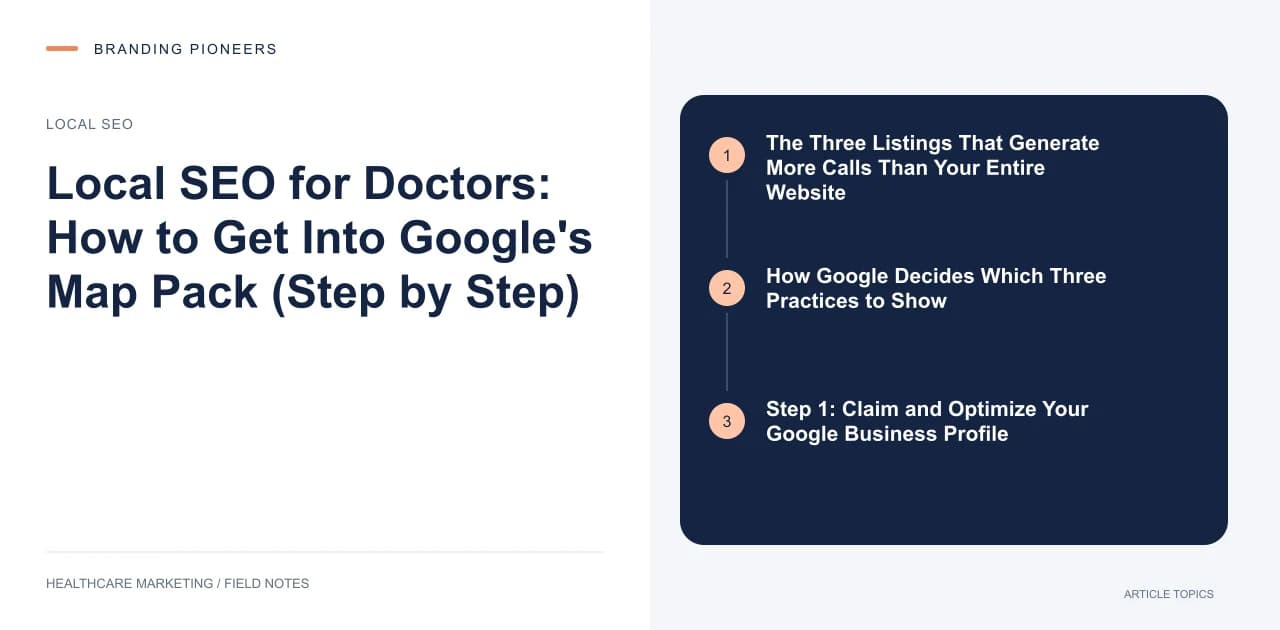
The Three Listings That Generate More Calls Than Your Entire Website
Pull out your phone. Search "orthopedic doctor near me." Before you see a single organic result, before you see any ads, there are three listings with a map. Name, star rating, address, phone number, hours. One tap to call.
That is the local map pack. And for most medical practices, those three listings generate far more patient calls than the organic results below them. The map pack captures the large majority of clicks on a local search. The first organic result picks up a good share of what remains, and everything else fights over the scraps.
If your practice is not in those top three listings for the searches that matter, you are invisible to nearly half of your potential patients.
The good news: getting into the map pack is not a mystery. It follows specific, repeatable steps. The bad news: most of your competitors are not doing them, which means if you start now, you will likely outpace them within 60 to 90 days.
How Google Decides Which Three Practices to Show
Google has publicly stated that local pack rankings depend on three factors: relevance, distance, and prominence. That sounds simple. The details are where practices win or lose.
Relevance means how well your listing matches what the patient searched. A patient searching "pediatric dentist" will see pediatric dental practices, not general dentists who also treat kids. Your Google Business Profile categories, services, and description determine relevance.
Distance means how close your practice is to the patient (or to the location they specified). You cannot change your address, but you can influence how Google defines your service area.
Prominence means how well-known and trusted your practice is. This is the factor you have the most control over. It includes online reviews, local citations, website authority, and Google Business Profile engagement.
Here is the general weighting we have observed across our healthcare local SEO work: prominence tends to matter most for ranking power, relevance close behind, and distance the least. Distance matters least — which means a practice 5 kilometers from the patient can outrank one that is 500 meters away if the farther practice has stronger prominence signals.
Step 1: Claim and Optimize Your Google Business Profile
If you have not claimed your GBP, you are giving away patients. Go to business.google.com, search for your practice, claim it, and verify. This takes 10 minutes plus verification time (3 to 14 days by postcard or instant by phone for eligible practices).
Once claimed, optimize everything:
Primary category. Choose the most specific option. "Dermatologist" ranks better for skin-related searches than "Doctor." "Orthodontist" ranks better than "Dentist" for braces-related queries. Your primary category is the single most important ranking factor you control.
Secondary categories. Add up to 9. If you are an orthopedic surgeon who also does sports medicine, joint replacement, and spine surgery — add all of those. Each category opens new search queries where your listing can appear.
Business description. Use all 750 characters. Write it naturally. Include your specialties, location, and what makes your practice different. Not keyword-stuffed — just specific. "Dr. Sharma Orthopedics provides joint replacement, sports injury treatment, and spine care in South Delhi. Board-certified with 15 years of experience and same-week appointments available."
Services. Add every service with a description. Google matches service descriptions to patient searches. If you do ACL reconstruction but do not list it as a service, you are invisible for "ACL surgery near me."
Attributes. Wheelchair accessible, online appointments, accepts new patients, LGBTQ-friendly, and every other applicable attribute. These show up in your listing and influence filter-based searches.
Photos. Minimum 10. Exterior (helps patients find you), reception, exam rooms, equipment, team photos. Update monthly. Listings with fresh photos get noticeably more direction requests. No stock photos — patients notice immediately.
Step 2: Earn Reviews Within the NMC Rules
Reviews are the single biggest prominence signal for local pack rankings. Not total reviews — review velocity (how many new reviews you get per month) and review recency.
Until October 2026, this step was an automated post-visit message asking every patient for a Google review in the doctor's name. For Indian doctors that is no longer an option. The National Medical Commission's guidelines of 6 October 2026 say a doctor "shall not request or share patient testimonials, recommendations, endorsements or reviews for professional promotion on social media" (Explanation V to para 3.2), and para 8.1(xii) bars manipulating reviews, ratings or search rankings. See our NMC guidelines hub for the full picture.
Here is what we now do instead:
For a doctor's own practice: no review requests. Keep the profile complete and accurate, make the experience worth writing about (shorter waits, clear billing, a phone that gets answered), and let patients review you on their own.
For hospitals and multi-doctor clinics: our conservative reading is that one neutral feedback message to every patient, sent in the hospital's name and not a doctor's, is defensible. It should offer a private feedback form and the public review link side by side, with no incentive and no "if you had a good experience" filter.
Key details:
- Never offer incentives for reviews (it violates Google's policies, can get your listing suspended, and in India breaches para 8.1(xii)).
- Never filter who receives the message by how satisfied they seem.
- Never buy reviews or use review-swap groups.
Expect slower review velocity than the old request-led systems produced. Compensate with the levers below: categories, photos, posts, NAP consistency and genuinely local content.
Responding to reviews: Reply to every single review within 24 hours. Positive reviews get a brief, personalized thank you. Negative reviews get a professional, empathetic response that moves the conversation offline. "We are sorry to hear about your experience. Please contact our patient relations team at [number] so we can make this right."
Never argue in review responses. Never disclose any patient information. Never get defensive. Every response is public and every prospective patient reads them.