Patient acquisition is not a campaign. It's a system. Hospitals that treat it as a campaign — run some ads, get some calls — are leaving a large share of potential patients on the table. Hospitals that treat it as a system — where every touchpoint is deliberate and connected — pay less per patient, get higher quality referrals, and retain patients longer.
This post walks through the full funnel as it actually works in 2026, based on the patterns we consistently see across the hospitals we work with.
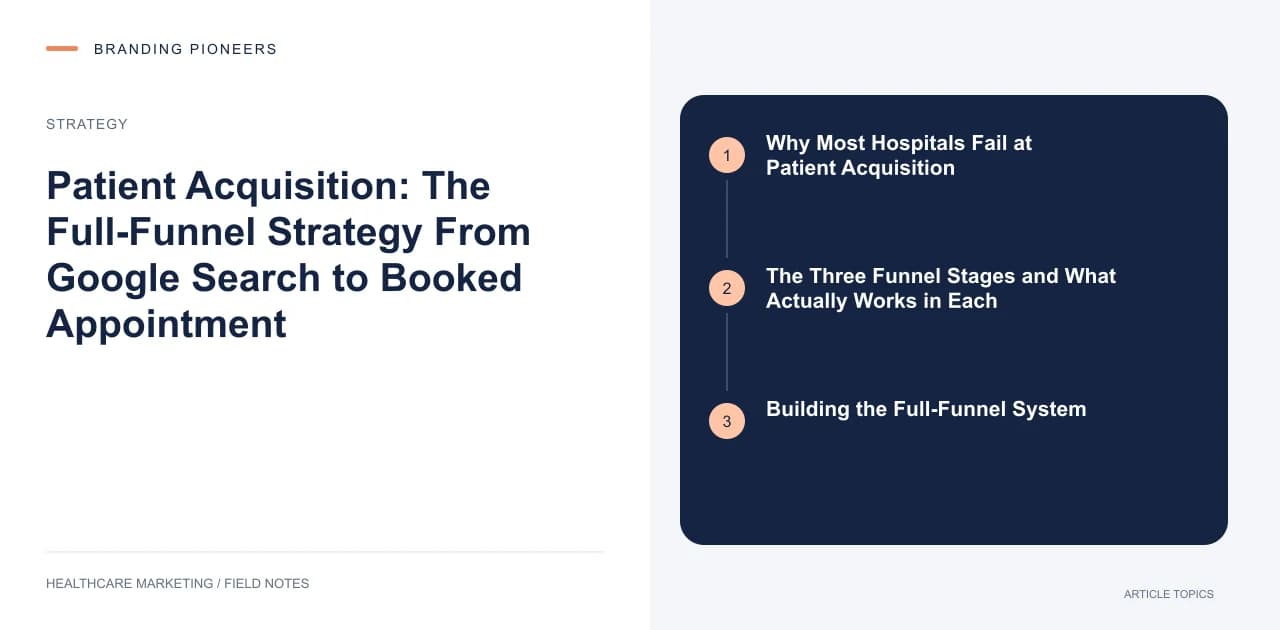
Why Most Hospitals Fail at Patient Acquisition
The typical hospital marketing team runs Google Ads sending traffic to a generic homepage. The homepage has no clear next step. There's a phone number but no online booking. Someone calls, gets put on hold, and books with the competitor instead.
We regularly audit hospital websites, and the large majority have this exact problem — a failure at the most basic step of acquisition.
The issue is a fragmented funnel. The awareness stage (ads, SEO, social) is managed by one team or agency. The consideration stage (website content, doctor profiles) is managed by another. The conversion stage (booking, follow-up calls) is managed by the front desk. Nobody owns the full picture.
The Three Funnel Stages and What Actually Works in Each
Stage 1: Awareness — Getting Found
In 2026, patients find hospitals through four main channels:
Google Search (organic): Most healthcare journeys start with a Google search. If you're not ranking in the top 3 for your core specialties in your city, you're invisible to the majority of potential patients. Hospitals that run a structured SEO program for several years can end up ranking for thousands of keywords across their core specialties in their city. That's not luck — it's sustained, consistent work.
Google Ads: For high-value procedures — joint replacement, IVF, cardiac surgery — paid search delivers immediate visibility. The average cost-per-click for "IVF clinic Delhi" is ₹180–₹240. If your landing page converts at 8%, you're paying ₹2,250–₹3,000 per lead. At 15% conversion, that drops to ₹1,200–₹1,600.
Social Media (organic + paid): Doctors with active Instagram or YouTube presences drive meaningful referrals. Individual doctors who run a consistent Instagram Reels program — a few short videos a week, each explaining a common knee or hip problem in 60 seconds — often see a meaningful lift in consultation bookings within a few months.
Word of mouth + Google Maps: Most patients check Google reviews before booking. A noticeably higher rating can mean a real difference in click-through from the Maps pack.
Stage 2: Consideration — Convincing Them You're the Right Choice
This is where most hospitals completely drop the ball. Someone finds your hospital on Google. They click through. What do they see?
A generic "About Us" page. A department list. A "Book an Appointment" button that goes to a contact form with no confirmation of next steps.
What patients actually need at this stage:
Doctor profiles with real depth. Not just name, designation, and a headshot. Credentials, years of experience, conditions treated, procedures performed, patient education videos, and — critically — the doctor's registration details (State Medical Council or NMR number). India's NMC guidelines of 6 October 2026 treat a hospital's doctor directory as patient information (para 9.1), but they rule out patient testimonials for promotion, even with consent (Expl. V to para 3.2; para 6.2). Hospitals that build doctor profile pages with real depth typically see a booking rate from those pages that's far higher than the site average.
Procedure-specific landing pages. A patient researching "knee replacement surgery" doesn't want your generic orthopaedics page. They want to know: what is the procedure, how long is recovery, what does it cost at your hospital (even a range), which doctors do it, and what are the risks and alternatives. Build a dedicated page for every high-value procedure.
Trust signals at every decision point. Accreditation status (NABH, JCI) stated factually, doctor qualifications and registration numbers, honest cost ranges, and short patient-education videos in which the doctor explains the procedure. Video testimonials, reshared reviews and before/after images used to be the default here; under NMC's 2026 guidelines they are off the table for promotion even with consent (para 6.2, 8.1(v)), while factual, verifiable institutional information is expressly allowed (para 8.3, 9.1).
Live chat or WhatsApp. A large share of patients, especially younger adults, prefer messaging over calling. If you don't have WhatsApp or live chat on your site, you're losing a meaningful segment.
Stage 3: Conversion — Turning Intent into a Booked Appointment
Conversion is where the money is made or lost. A 1% improvement in conversion rate is often worth more than doubling your ad spend.
Online booking that actually works. This sounds basic. It isn't. Most hospital booking systems are broken — they require too many fields, don't show real availability, and have no immediate confirmation. The benchmark: 3 fields maximum (name, phone, preferred date), confirmation SMS within 60 seconds, human callback within 4 hours.
WhatsApp follow-up for incomplete bookings. Someone fills in 2 fields and abandons. Send a WhatsApp message within 15 minutes: "Hi, we noticed you were looking to book an appointment. Can we help?" This kind of automation typically recovers a meaningful share of abandoned bookings.
Speed of response. Responding to a healthcare lead within 5 minutes instead of 30 minutes makes a dramatic difference to the likelihood of conversion — far more than most people expect. Most hospitals respond in 24–48 hours.
Building the Full-Funnel System
Here's the architecture that connects all three stages:
- Traffic sources (Google Ads + SEO + Social) feed into specialty-specific landing pages (not your homepage)
- Landing pages have a single CTA: book a consultation (not "learn more," not "contact us")
- Bookings go into a CRM (Zoho, HubSpot, or a hospital-specific system) that triggers an immediate confirmation SMS + email
- Leads that don't convert within 24 hours get a WhatsApp follow-up from the patient coordination team
- All conversions get tagged back to their source so you know exactly which campaign, which keyword, which ad drove revenue
This isn't complicated. Most hospitals simply haven't connected these pieces.