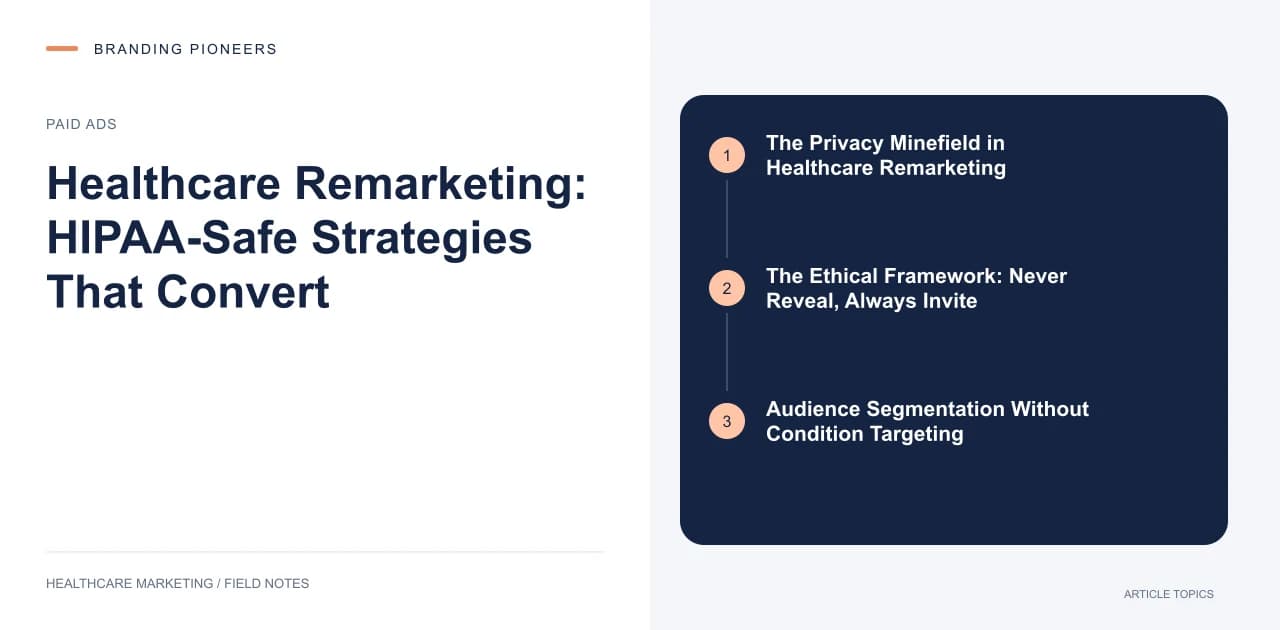
The Privacy Minefield in Healthcare Remarketing
Remarketing — showing ads to people who previously visited your website — is one of the most cost-effective digital advertising strategies. For healthcare, it is also one of the most sensitive. Showing someone an ad for depression treatment because they visited your mental health page is not just a bad look — it can be a regulatory violation and a devastating breach of patient trust.
Yet the opportunity is enormous. The vast majority of healthcare website visitors leave without booking an appointment. Many of them are genuinely interested but not ready to commit. Remarketing, done correctly, brings these warm prospects back at a fraction of the cost of acquiring new visitors.
The key is designing campaigns that are effective without being identifiable. Here is how.
The Ethical Framework: Never Reveal, Always Invite
The fundamental rule of healthcare remarketing is that your ads should never reveal or imply what health condition or treatment the user was researching. An ad that says "Still considering knee replacement?" to someone who visited your orthopedics page crosses the line. An ad that says "Trusted orthopedic care — book your consultation" does not.
Frame all remarketing ads around your practice's general expertise and trustworthiness, not the specific condition the user researched. This is not just ethical — it is practically more effective. Patients respond better to authority-building ads than to ads that feel like they are being tracked.
Audience Segmentation Without Condition Targeting
You can segment your remarketing audiences by page category without making the ads condition-specific. Create audiences based on broad website sections: visitors to any service page, visitors to the appointment booking page who did not complete, visitors to your physician profiles, and visitors who spent more than two minutes on your site.
Avoid creating audiences based on specific condition pages. A remarketing audience of "people who visited the depression treatment page" is both a privacy risk and a Google Ads policy violation for healthcare advertisers. Keep your segments broad enough that no individual ad impression reveals health information.
The Three-Wave Remarketing Sequence
Structure your remarketing into three waves, each with different messaging:
Wave 1 (Days 1 to 7): Authority and trust. Serve ads that position your practice as a trusted, credentialed provider. Feature your doctors' credentials, hospital affiliations, years of experience, and patient satisfaction ratings. These ads remind visitors why they came to your site in the first place.
Wave 2 (Days 8 to 14): Social proof. Serve ads featuring patient testimonial snippets (with consent), review ratings, media mentions, or awards. (Check local rules first: in India, NMC's 2026 guidelines bar doctors from requesting or sharing patient testimonials, even with consent — see our NMC guide; in Australia, AHPRA bans testimonials about clinical aspects; Ontario and Alberta bar physician testimonials; and in the UAE, health ads need DHA, DoH or MOHAP approval before they run.) Social proof is the single most effective remarketing creative type in healthcare — it converts at roughly twice the rate of standard brand ads.
Wave 3 (Days 15 to 30): Low-friction offer. Serve ads with a specific, low-commitment call-to-action: a free consultation, a second opinion offer, or an educational webinar. This wave catches patients who needed time to decide and gives them a reason to re-engage.
After 30 days, remove users from your remarketing audience. Beyond that window, continued ad exposure feels intrusive and generates diminishing returns.
Platform-Specific Compliance
Google Ads has specific restrictions for healthcare remarketing. You cannot use personalized advertising for sensitive health categories including mental health, reproductive health, substance abuse, and chronic conditions. For these specialties, use Google's "limited ads" approach — contextual placement without personalized targeting.
Meta (Facebook and Instagram) has similar restrictions. Healthcare advertisers cannot use Custom Audiences based on website activity for sensitive health topics. You can, however, use broad interest targeting and lookalike audiences built from your patient email list (uploaded via a hashed, HIPAA-aligned process).
YouTube remarketing is often overlooked by healthcare practices but is highly effective. Video ads featuring doctor introductions, facility tours, or patient education content generate strong engagement from remarketing audiences at lower cost than display or search remarketing.
Landing Page Strategy for Remarketing Traffic
Remarketing visitors are qualitatively different from first-time visitors. They already know your practice exists — they need a reason to take the next step. Your remarketing landing pages should prioritize reducing friction: prominently display your phone number and a simple booking form, feature trust signals at the top of the page, and include a clear "next step" that does not require a major commitment.
A/B test different landing pages for your remarketing traffic. We consistently find that pages with video testimonials convert remarketing visitors at 25 to 40 percent higher rates than pages with text-only testimonials.
Measuring Remarketing ROI in Healthcare
Track these metrics for each remarketing wave: impression frequency (keep it below 7 impressions per user per week to avoid ad fatigue), click-through rate by wave and creative, conversion rate by wave, cost per conversion compared to your prospecting campaigns, and view-through conversions (patients who saw but did not click the ad, then later booked directly).
View-through conversions are particularly important in healthcare remarketing. Many patients see a remarketing ad, do not click it, but later search for your practice name directly and book. Without view-through tracking, you would undercount remarketing's true contribution by 30 to 50 percent.
Healthcare remarketing typically delivers cost per acquisition 40 to 60 percent lower than prospecting campaigns. Even with the necessary privacy constraints, it remains one of the highest-ROI channels available to healthcare marketers.
Filed underhealthcare remarketingmedical retargetingHIPAA remarketingpatient retargeting ads

About the author
Arush Thapar
Co-Founder & CTO · Gurugram, India
Arush builds the systems the rest of the company runs on — the patient-acquisition pipelines, the AI chatbots, the analytics that tie a single click to a booked appointment. If a campaign reports a number, it's because something his team built is tracking it.
Free guide · 17 pages
The Patient Acquisition Blueprint
A 90-day plan from first search to booked appointment.