Take a 200-bed multispecialty hospital in Noida facing a common question: "Why are we spending ₹18 lakhs a month on digital marketing and only getting 380 new OPD patients?"
The math: ₹18,00,000 ÷ 380 = ₹4,736 per patient. For OPD consultations averaging ₹800–₹1,200, this made no financial sense.
Six months after making the fixes below, a hospital in this position could plausibly be getting 940+ patients at ₹2,100 each — spending ₹19.5 lakhs. Digital-attributed revenue could grow from roughly ₹1.8 crore to ₹4.2 crore per month.
This is not a success story about spending more. It's about fixing what was broken.
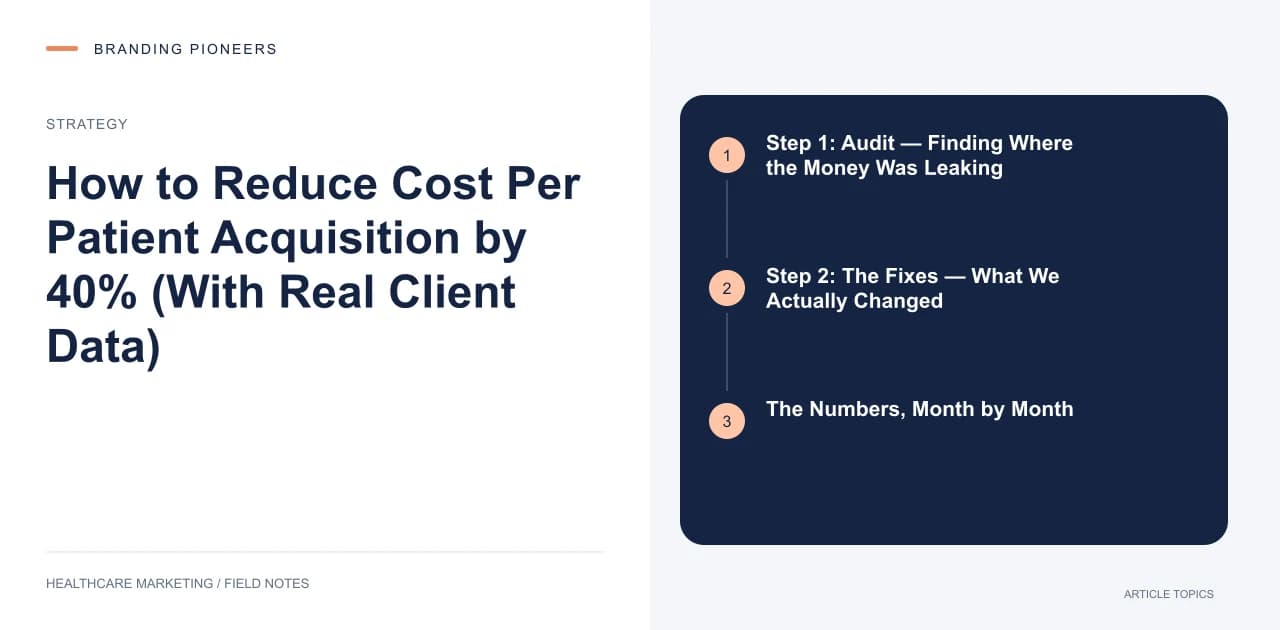
Step 1: Audit — Finding Where the Money Was Leaking
The first thing we did was not run a single new ad. We audited every step of the existing funnel over two weeks.
Finding 1: 60% of ad spend was going to the wrong keywords.
The hospital was bidding on broad terms like "hospital near me" and "doctor in Noida." These sound logical. But they attract the wrong traffic — people looking for a GP, people with insurance queries, people comparing costs with no intent to book. Cost-per-click for these terms: ₹65–₹90. Conversion rate from this traffic: 0.4%.
High-intent keywords like "knee replacement surgeon Noida," "IVF specialist Noida cost," and "cardiac surgery hospital Noida" had CPCs of ₹120–₹180 — but conversion rates of 3.8–5.2%.
The math at a campaign level:
- Broad traffic: ₹75 CPC × 1,000 clicks × 0.4% CVR = 4 patients @ ₹18,750 each
- High-intent traffic: ₹150 CPC × 500 clicks × 4.5% CVR = 22 patients @ ₹3,409 each
Same budget. 5.5x more patients. Just from fixing keyword targeting.
Finding 2: The website was converting at 1.4% — half the industry benchmark.
The hospital's Google Ads were sending traffic to the homepage. The homepage had 14 navigation items, 3 rotating banners, and a phone number buried in the footer. There was no online booking form. The only action a visitor could take was to call.
Of those who called, the front desk was unavailable or on hold 40% of the time during peak hours (11am–2pm and 5pm–8pm).
Finding 3: Zero follow-up on unconverted leads.
The hospital had a contact form that got about 180 submissions per month. Of these, 60 were responded to within 24 hours. The remaining 120 got no follow-up.
Step 2: The Fixes — What We Actually Changed
Fix 1: Keyword Surgery
Paused all broad and phrase-match keywords with CPAs above ₹3,500. Built tightly themed ad groups for 8 core specialties: orthopaedics, cardiology, neurology, IVF/fertility, oncology, ophthalmology, gastroenterology, and general surgery.
Each ad group got:
- 5–8 exact-match and phrase-match high-intent keywords
- 3 ad variations with the procedure name and city in the headline
- A dedicated landing page (not the homepage)
Fix 2: Procedure Landing Pages
Built 8 procedure-specific landing pages. Each page had:
- A clear headline matching the search query (e.g., "Knee Replacement Surgery in Noida")
- Doctor profile with credentials and a photo
- NABH accreditation and the surgeon's registration number, stated factually
- Procedure details: what to expect, recovery time, approximate cost range
- A simple 3-field booking form: name, phone number, preferred appointment date
- A WhatsApp button for immediate messaging
Conversion rate on these pages: 5.8–8.2%. The old homepage: 1.4%.
Fix 3: WhatsApp Automation for Unconverted Leads
Set up a simple automation: any form submission that didn't get a confirmation of appointment booking within 2 hours triggered a WhatsApp message from the patient coordination team.
Message template: "Hi [Name], we received your appointment request for [Specialty]. Our team is ready to help. Would you prefer a morning or afternoon appointment? Reply here or call us at [number]."
Recovery rate: 22% of previously lost leads converted within 48 hours of receiving this message.
Fix 4: Speed of Response
The front desk call overflow problem was solved with a simple change: a dedicated WhatsApp number for appointment bookings, monitored by 2 coordinators during peak hours. Volume on phone dropped by 35%. WhatsApp bookings went from 0 to 180/month in 90 days.
The Numbers, Month by Month
| Month | Spend (₹L) | New Patients | Cost/Patient |
|---|---|---|---|
| Jan (baseline) | 18.0 | 380 | ₹4,736 |
| Feb (audit + setup) | 16.5 | 410 | ₹4,024 |
| Mar (landing pages live) | 17.2 | 580 | ₹2,966 |
| Apr (WhatsApp automation) | 18.8 | 780 | ₹2,410 |
| May (full optimization) | 19.5 | 940 | ₹2,074 |
| Jun (projected) | 20.0 | 1,050+ | ₹1,904 |
That's a 56% reduction in cost per patient in 5 months, with a 147% increase in patient volume.