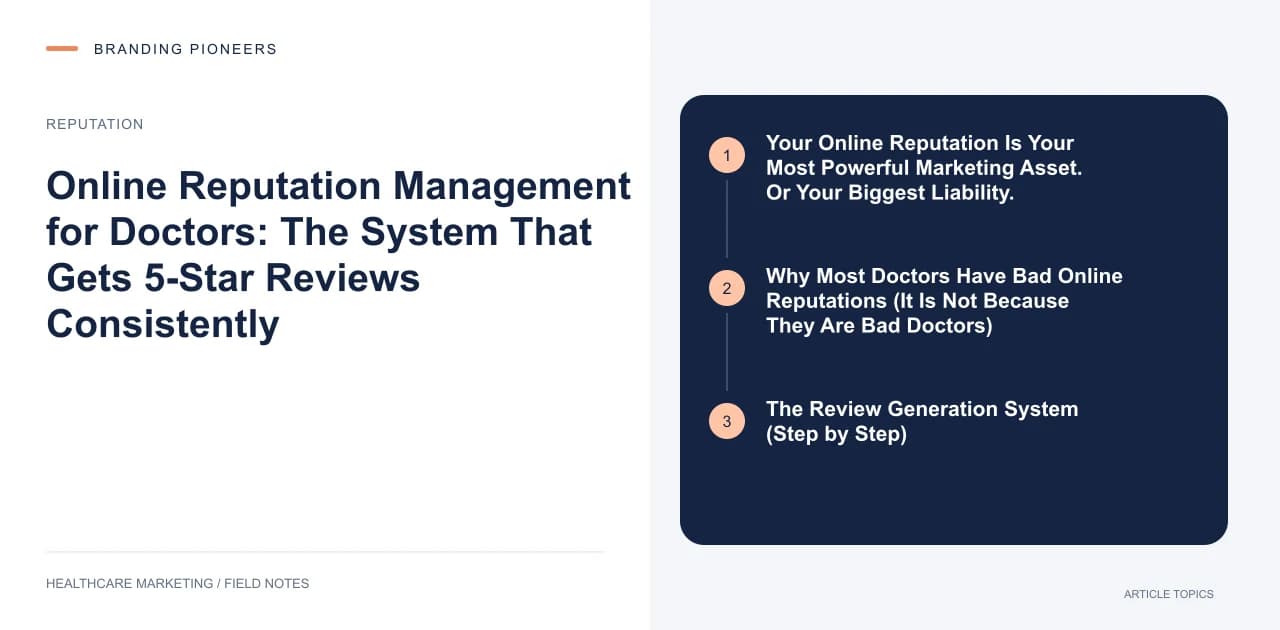
Your Online Reputation Is Your Most Powerful Marketing Asset. Or Your Biggest Liability.
Say a patient is deciding between two orthopedic surgeons. Both are board-certified. Both work at reputable hospitals. Both were recommended by a friend. The patient opens Google.
Surgeon A: 4.7 stars, 280 Google reviews, most recent review posted 3 days ago. Surgeon B: 3.9 stars, 45 Google reviews, most recent review posted 4 months ago.
The patient calls Surgeon A. Does not even visit Surgeon B's website.
This scenario plays out thousands of times every day. Most patients check online reviews before choosing a healthcare provider, a large share will not consider a provider with fewer than 4 stars, and many say online reviews are "as important as personal recommendations."
Your clinical skills, your training, your years of experience — none of it matters to the patient who never calls because your Google rating is weak.
Reputation is one of the things we manage every day. The system below is built to move a struggling profile toward a stronger rating and a much larger base of reviews, and from invisible on Google Maps to dominating the local pack. It is not complicated. It is consistent.
Why Most Doctors Have Bad Online Reputations (It Is Not Because They Are Bad Doctors)
There is a fundamental asymmetry in healthcare reviews: unhappy patients leave reviews voluntarily. Happy patients do not.
A patient who waited 90 minutes past their appointment time, felt rushed during a 5-minute consultation, and received a bill higher than expected will go home and write a 3-paragraph Google review that same evening. A patient who had a successful knee replacement, walked out of the hospital pain-free for the first time in years, and is grateful to their surgeon will... tell their spouse about it. Maybe.
The result: your online reputation disproportionately represents your worst patient experiences. Your average Google rating is not a reflection of your clinical quality. It is a reflection of how few happy patients you have asked to leave reviews.
This is fixable. Not by providing better care (you are probably already doing that). By building a system that captures the positive experiences that currently go undocumented.
The Review Generation System (Step by Step)
First, a market check. If you practise in India, read this system with the National Medical Commission's 6 October 2026 guidelines beside you. A doctor "shall not request or share patient testimonials, recommendations, endorsements or reviews for professional promotion on social media" (Explanation V to para 3.2), and no one may solicit, buy or manipulate reviews or ratings (para 8.1(xii)). For an Indian doctor's own practice, that rules out Steps 1 and 2 below: keep your profiles accurate, reply to every review and let patients review you on their own. Hospitals can, on our conservative reading, send one neutral, unincentivised message to every patient in the institution's name, never a doctor's. Our NMC guidelines hub explains the detail. In the US and UK, neutral requests to every patient are generally acceptable; in Australia, AHPRA bars reusing reviews about clinical aspects in advertising.
Step 1: Identify the Ask Moment
Timing is everything. The best moment to ask for a review is when the patient's positive experience is freshest.
For outpatient visits: 2 to 4 hours after the appointment. The patient is home, the visit is fresh, and they have not yet moved on to the rest of their day.
For surgical procedures: 3 to 7 days after discharge. The patient has recovered enough to feel grateful but the experience is still top of mind.
For dental procedures: Immediately after, or 24 hours later for more involved treatments.
For ongoing treatment (IVF, physiotherapy, chronic care): At a fixed point in the pathway, such as the end of a treatment phase, for every patient. Timing the ask to good news (a positive pregnancy test, a good lab result) skews your reviews towards the lucky and quietly turns a request into a filter.
Step 2: The Two-Channel Ask
We use two channels simultaneously because different patients respond to different formats.
Channel 1: In-person ask (highest conversion rate)
Train your front desk staff or nursing team to ask every patient the same way, not just the ones who seem pleased: "We would value your feedback. If you would like to leave a Google review, this card takes you straight there."
Hand the patient a card with a QR code that links directly to the Google review writing screen. Not your Google listing. Not your website. The review writing screen. Every tap you eliminate between the ask and the review meaningfully increases completion.
Completion rate for in-person asks: strong — a meaningful share of patients follow through.
Channel 2: Automated message (scalable, consistent)
2 to 4 hours after the appointment, an automated WhatsApp message (or SMS):
"Hi [Patient Name], thank you for visiting [Practice Name] today. We would value your feedback, good or bad. You can tell us privately here: [feedback link], or leave a public Google review here: [review link]."
Keep it short, send it to everyone, and keep both links direct. Leave out "if you had a good experience": that phrase is a filter.
Completion rate for automated messages: much lower, but scalable since it requires no staff time.
Combined, these two channels consistently generate 8 to 15 new reviews per month for a practice seeing 30+ patients per day. That velocity is enough to outpace competitors and steadily improve your overall rating.
Step 3: The Private Feedback Channel (Alongside, Never Instead)
This is the part most reputation guides get wrong.
A common tactic is the "feedback intercept": ask patients how their visit went, send the happy ones to Google and route the unhappy ones to a private form. That is review gating. It breaches Google's review policies, FTC guidance treats it as potentially deceptive in the US, UK consumer-law guidance covers it expressly, an Australian court found that filtering out likely-negative reviewers was misleading, and in India it is the kind of rating manipulation para 8.1(xii) of the NMC guidelines prohibits.
The compliant version gives every patient both options at once: a private feedback form that goes to your practice manager, and the public review link. Many unhappy patients will still choose the private route, because they want the problem fixed rather than a public argument. Respond to every private complaint personally and quickly. Patients who feel heard often become loyal patients, and the operational fixes they point you to are what lift your public rating over time.
Step 4: Review Response Protocol
Responding to reviews is not optional. It affects your Google ranking (review engagement is a local SEO signal) and it affects how prospective patients perceive your practice.
For positive reviews (respond within 24 hours):
Keep it brief, personal, and warm. "Thank you, [Patient Name]. We are glad the visit went well and appreciate you taking the time to share your experience. Looking forward to seeing you for your follow-up."
Do not use the same template for every response. Vary your wording. Reference something specific from their review if possible. Google and patients both notice copy-paste responses.
For negative reviews (respond within 12 hours):
This is where most practices panic. Do not panic. Follow this framework:
- Acknowledge. "Thank you for sharing your experience. We take this seriously."
- Empathize. "We understand how frustrating long wait times can be."
- Move offline. "We would like to discuss this directly. Please contact our patient relations team at [number/email] so we can make this right."
- Never argue publicly. Never get defensive. Never disclose any medical details.
- Never offer compensation publicly. This invites gaming.
The response is not for the unhappy patient (they may never see it). It is for the 100 prospective patients who will read it and judge how you handle complaints. A graceful, empathetic response to a negative review often builds more trust than a positive review does.
Step 5: Handling Fake and Unfair Reviews
It happens. A competitor posts a fake review. A patient who never visited your practice leaves a 1-star review. Someone confuses your clinic with another one.
For fake reviews:
- Flag the review through Google Business Profile (select "Flag as inappropriate")
- If the review violates Google's policies (fake, spam, conflict of interest), it may be removed within 7 to 14 days
- If Google does not remove it, respond professionally: "We cannot find any record of your visit in our system. If there has been a mix-up, please contact us at [number] so we can help."
- For persistent fake review campaigns, contact Google Business Support directly or use the Google Business Redressal Form
For unfair but genuine reviews:
A patient who gave you 1 star because parking was difficult or because their insurance did not cover the full cost. These are genuine experiences, even if the review feels unfair.
Respond empathetically, address the specific issue, and explain what you are doing to improve. "You are right that parking can be challenging during peak hours. We are adding a valet service starting next month to make this easier." Prospective patients reading this see a practice that listens and improves.